Chronostasis: Why the Clock's First Second Lasts Too Long
The clock doesn't stop. It stretches by a tenth of a second — exactly as long as your eye took to move.

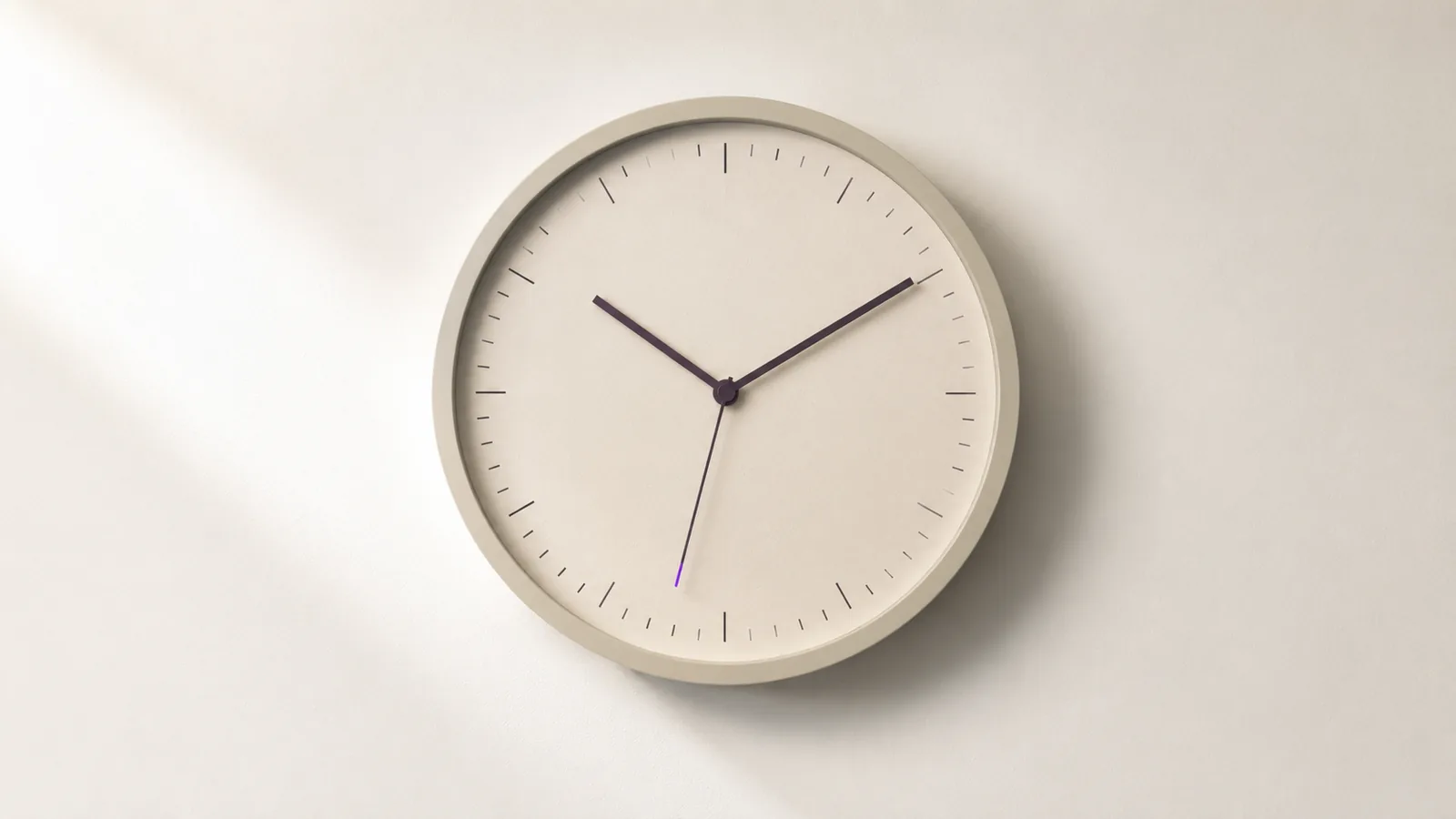
Glance at a clock with a ticking second hand and the first tick after your eyes land often seems to take too long, as if the clock had hesitated. This is saccadic chronostasis, and it is real. It is also much smaller than the name suggests: the overestimate is about 120 milliseconds for a modest eye movement, not a second. The size turns out to be the most informative thing about it, because it matches how long the eye movement itself took.
The effect is a genuine, replicated distortion of perceived time with a tidy quantitative structure. The popular version overstates it by roughly a factor of eight, and the explanation usually given for it is contested within the field that discovered it.
The illusion, precisely stated
When you make a rapid eye movement — a saccade — to a new target, the first thing you see at the new location appears to have begun slightly earlier than it did. The interval seems stretched.
The clock version is popular because a ticking second hand gives you a reference. You know each tick is a second, so a first tick that feels longer is noticeable. But nothing about the illusion requires a clock. It happens whenever you saccade to something that changes, and the clock merely hands you a ruler.
How big it actually is
Kielan Yarrow, Patrick Haggard and colleagues measured it in Nature in 2001, and the design is worth describing because the numbers depend on it.
Participants made saccades of 22 or 55 degrees to a counter that began changing digits. The first digit's display time was varied to find the duration at which it was judged equal to the one-second digits that followed. Thirty participants took part in the main experiment.
With a 22-degree saccade, a first digit shown for 880 milliseconds was judged to last a full second — an overestimate of about 120 milliseconds. With a 55-degree saccade, the figure was 811 milliseconds, an overestimate of about 189 milliseconds.
So the clock does not pause. The clock's first second is stretched by about a tenth of one, which is small enough that noticing it at all is slightly impressive, and nowhere near the "the clock seemed to stop" of the popular description.
The scaling is where it gets interesting. The 22-degree saccades took an average of 72 milliseconds to execute and the 55-degree saccades 139 milliseconds — a difference of 67 milliseconds, closely matching the 69-millisecond difference in the illusion. The whole data set fits a simple rule: overestimation equals saccade duration plus a constant of roughly 50 milliseconds.
This is the opposite kind of time distortion from the one most people have noticed in themselves. Here a specific interval is stretched by a predictable number of milliseconds for a mechanical reason, whereas the sense that whole years pass faster as you get older is a retrospective judgement about periods you are no longer in.
Why there is a gap to fill
Saccades are violent. The eye accelerates to several hundred degrees per second, and during flight the image on your retina is a smear carrying almost no usable information.
Vision handles this with saccadic suppression: sensitivity drops sharply around the movement, and the smeared input is largely discarded. You do not experience the blur, which is why watching someone else's eyes dart about is unremarkable while your own vision feels continuous.
That continuity is a construction. Something has to account for the missing tens of milliseconds, and chronostasis looks like the seam — the place where the join between before and after the saccade was made, with the first post-saccadic percept extended backwards over the gap.
The antedating account, and the trouble with it
The original proposal was antedating: the onset of the post-saccadic stimulus is timestamped to roughly when the eye began moving rather than when it arrived, so the first interval inherits the duration of the saccade. The arithmetic fits — saccade duration plus a constant — which is why the account became standard.
The complications are substantial, and Yarrow's own review sets most of them out.
- If the saccade target jumps to a new position during the movement, the effect disappears. A simple antedating mechanism should not care where the target ended up, which suggests a retrospective interpretive process rather than an automatic timestamp.
- Hunt and colleagues reported in 2008 that observers could discriminate a symbol presented during the saccade itself, which is awkward for accounts that assume mid-flight input is simply unavailable.
- A patient with congenital ophthalmoplegia, who made saccade-like head movements instead of eye movements, showed no prolongation of the first interval — which points to something specific to the oculomotor system rather than to movement generally.
- In the key trigger-time control experiment, the corrected difference was 11 milliseconds and not significant, while an uncorrected reanalysis gave a significant 75 milliseconds. The authors are explicit that this rests on a negative result with limited power.
Several alternatives have been floated and none has displaced it. Changes in internal clock rate struggle with the finding that the effect is independent of the reference duration across a range from 100 to 1333 milliseconds. Arousal accounts have no supporting evidence. Response bias and demand characteristics cannot be fully excluded, though the reasoning participants would have to do is implausibly sophisticated.
The state of play, then: a well-replicated effect with a clean quantitative signature, a leading explanation that fits the arithmetic, and at least four findings that explanation does not comfortably accommodate. That is a normal mid-life condition for a result in this field, and worth saying plainly rather than smoothing over.
It is not only eyes
Chronostasis generalises beyond saccades, which both supports the general idea and complicates the specifics.
Reaching towards a tactile stimulus produces overestimation of 60 to 120 milliseconds — and unlike the saccadic version, it does not scale with how far you reached, so whatever sets the magnitude there is not movement duration. Alexander and colleagues found auditory chronostasis of about 160 milliseconds when tones were presented to different ears, which is larger than the visual effect. A key press starting a visual digit sequence produced around 70 milliseconds in one study, though Hunt and colleagues found it in two experiments and not in three similar ones.
Within vision the effect is indifferent to how the saccade was produced: self-timed, reflexive and deliberately anti-directed saccades all give similar magnitudes. That argues against an account built on intention or voluntary control.
Why it is not really a clock illusion
Calling this the stopped-clock illusion has done it a disservice. It frames a general property of perceived time as a quirk involving timepieces, and it invites the reasonable but mistaken inference that the effect is as large as the phrase suggests.
The underlying point is more interesting. Your sense of when something happened is not a readout of when the signal arrived. It is an assignment, made after the fact, by a system reconciling inputs that arrived at different times through channels with different delays — the same general property that makes the end of an experience count for so much more than its middle when you judge afterwards how long or how bad it was.
Chronostasis is a case where that assignment can be caught making a specific, measurable, predictable error, which is rarer and more useful than a large one.
Testing it on yourself
This is one of the few effects in this hub you can check without equipment, though you should expect something subtle.
- Find a clock with a second hand that ticks in discrete steps. A smooth sweep hand will not work, and neither will a digital display with no visible transition.
- Look away — properly away, a large eye movement, not a glance.
- Flick your eyes back to the second hand and attend to the first tick after your eyes land.
- Compare it with the ticks that follow. The first should feel slightly long.
- Repeat several times. A tenth of a second is near the edge of what you can notice, so single attempts prove nothing.
Larger eye movements give a larger effect, which is the one prediction you can test informally: compare a glance from the far side of the room with one from just beside the clock. And if you feel nothing at all, that is an unremarkable outcome for an effect this size — it was measured with staircase procedures across many trials, not by introspection.
Same trick, different system
Why Your Eyes Water When You Yawn
Frequently asked questions
A brief overestimation of the duration of the first thing you see after a rapid eye movement. The best-known version is the stopped-clock illusion, where the first tick of a second hand after you look at it seems to last too long. It also occurs for touch and hearing, and has been measured after reaching movements and key presses.
About 120 milliseconds for a 22-degree eye movement and about 189 milliseconds for a 55-degree one, measured against a one-second reference. That is roughly a tenth of a second — far less than the popular description implies. The magnitude closely tracks the duration of the saccade itself, plus a constant of around 50 milliseconds.
The leading explanation is antedating: the onset of what you see after the saccade is timestamped to roughly when the eye started moving rather than when it arrived, so the first interval absorbs the duration of the movement. The arithmetic fits well, but several findings sit awkwardly with it, including the fact that the effect disappears if the target moves mid-saccade.
Yes. The clock is incidental — it simply provides a known reference against which a stretched interval is noticeable. The effect occurs whenever you make a saccade to something that changes, and equivalent effects have been measured in hearing, where the magnitude is larger at around 160 milliseconds, and in touch.
Neither. It appears to be a side effect of maintaining continuous visual experience across eye movements, during which the retinal image is a smear and sensitivity drops. Something has to bridge the gap, and extending the first post-saccadic percept backwards over it produces a small, systematic timing error in exchange for a seamless experience.
This article is educational science trivia about everyday human biology and psychology. It is not medical advice, diagnosis, or treatment, and it is not a substitute for care from a qualified professional.