The Rubber Hand Illusion: How Easily Your Brain Adopts a Fake Limb
The demonstration always works. What it proves is a much harder question.

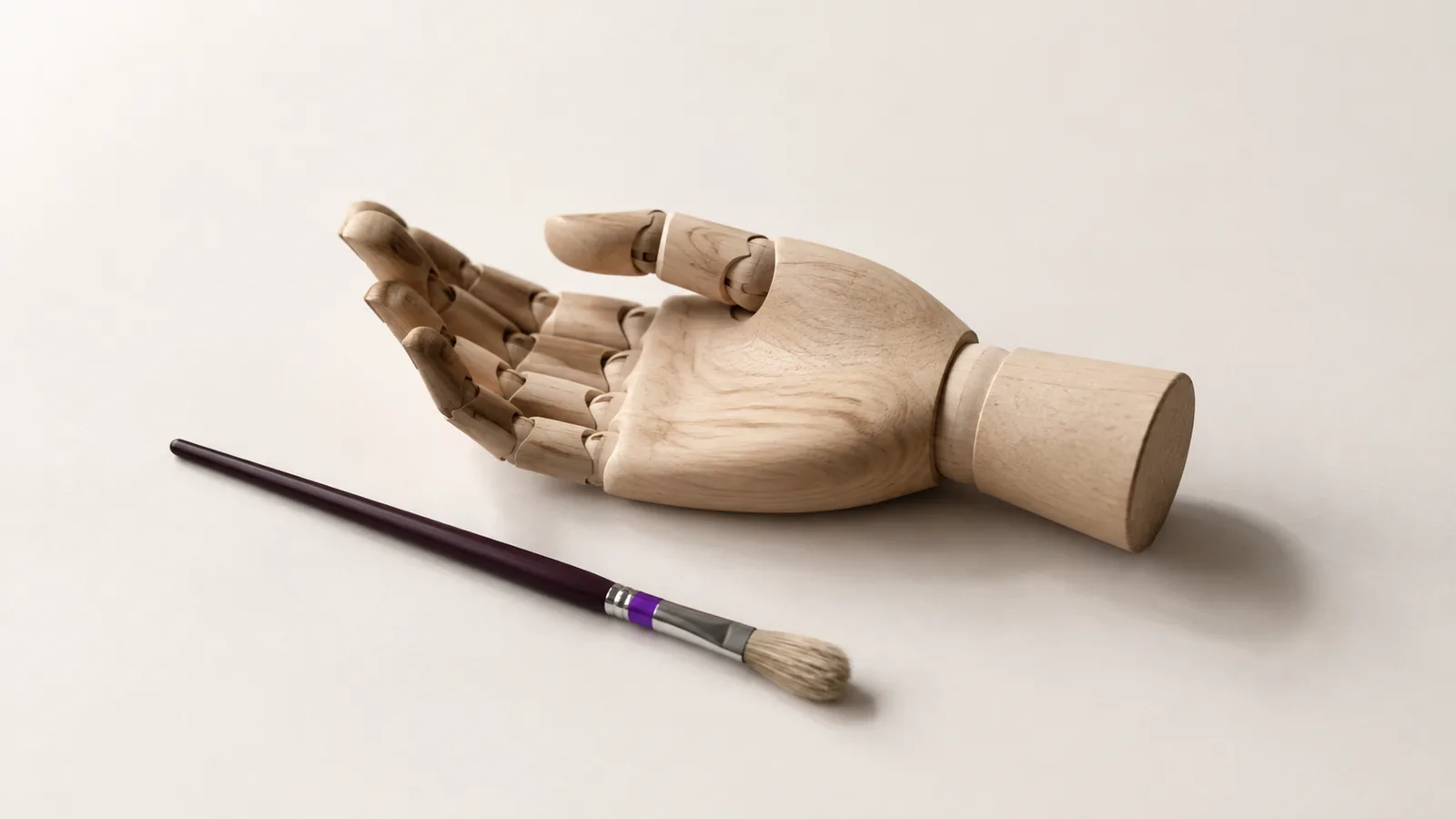
Hide your hand behind a screen, put a rubber hand where yours should be, and have someone stroke both with identical brush movements at the same moment. Within minutes many people report the rubber hand feeling like their own. The demonstration is real and easy to reproduce. What it proves is much less settled than its fame suggests, because both of its standard measurements have turned out to be challengeable — and one challenge comes from the illusion's own measurement logic.
This is one of the most reproduced demonstrations in cognitive science and simultaneously one of its most contested. Those two facts are not in tension, and understanding why is more useful than the demonstration itself.
The 1998 experiment
Matthew Botvinick and Jonathan Cohen published it in Nature as a single page. Ten participants sat with their left hand hidden behind a screen and a life-sized rubber left hand placed in plausible alignment in front of them. An experimenter stroked the real hand and the rubber hand with two small brushes, matched in timing and position, for ten minutes.
Afterwards participants rated nine statements on a seven-point scale. Four of them — feeling the touch where the rubber hand was seen being touched, feeling the touch as caused by the brush on the rubber hand, feeling the rubber hand as one's own, and feeling the real hand drifting towards it — drew significant agreement.
The other five were controls describing things that should not happen, such as having two left hands. They drew no agreement, which made the result publishable.
Why vision wins
The standard interpretation is multisensory integration. Your sense of where your hand is comes from several sources: proprioception from muscles and joints, touch from the skin, and vision. Normally they agree, and no arbitration is needed.
The rubber hand setup makes them disagree. Touch says a brush is on your hand. Vision says the brush is twenty centimetres to the left, on that hand there. Timing says the two events are the same event, because they are perfectly synchronous, and synchrony is the strongest evidence the nervous system has that two signals share a cause.
Given a forced choice, the system weights vision heavily — spatial information is where vision is most reliable, and the brain weights each channel roughly by its precision. The location of the touch gets reassigned to the visible hand, and on the standard account the sense of ownership follows the touch.
This is the same arbitration you can hear in the McGurk effect, where watching lips say one syllable while hearing another changes what you hear rather than producing a sense of conflict. The losing sense does not report being overruled. It reports the revised answer.
The number that gets quoted
The 1998 paper included a second measure intended to be more objective than a questionnaire: proprioceptive drift. Participants reached for their own hidden hand before and after the stroking period. Afterwards, those in the synchronous condition reached about 23 millimetres further towards the rubber hand. The asynchronous control group drifted about 13 millimetres the other way.
That 23 millimetres has been quoted thousands of times as hard evidence for felt ownership. It is also the figure that has aged worst.
One more number from the original paper deserves more attention than it gets. Asked what proportion of the exposure period the illusion was present for, the synchronous group said 42 per cent, against 7 per cent for the asynchronous control. The difference is clear and the effect is real — but 42 per cent is not a continuous, compelling experience of owning a false hand. It is an intermittent one, in a group that had been stroked for ten minutes.
First problem: drift is not ownership
In 2011 Marieke Rohde, Massimiliano Di Luca and Marc Ernst tested whether proprioceptive drift tracks the feeling of ownership. It does not.
Their first experiment found drift of 6.50 centimetres with synchronous stroking and 3.93 centimetres with asynchronous stroking — a difference that was not statistically significant, even though questionnaire ownership ratings were positive only in the synchronous group. The objective measure failed to distinguish conditions the subjective measure separated cleanly.
The second experiment was worse for drift. With no stroking at all — just looking at the rubber hand — drift reached 6.47 centimetres, statistically indistinguishable from synchronous stroking. Vision of a plausibly placed fake hand is sufficient to shift where you think your real hand is, no touch required.
The authors' conclusion is narrow and well supported: drift reflects the integration of vision and proprioception, which is a different process from ownership, so drift cannot be used as a proxy for ownership. A great deal of subsequent work had been using it as exactly that.
Second problem: suggestion
The deeper challenge arrived in 2020. Peter Lush and colleagues reported that trait phenomenological control — measured by a standard hypnotisability scale, and describing how readily someone generates experiences in response to imaginative suggestion — predicts how strongly people report the rubber hand illusion.
In a sample of 353 participants, hypnotisability predicted agreement with the ownership statement, with a correlation of about 0.27 and roughly a 0.6-point rise in reported illusion per scale point. The argument is not that the illusion is fake. It is that the experiment's design cannot separate a multisensory effect from a response to expectation.
The crux is the control condition. Asynchronous stroking is meant to be the comparison that rules out suggestion, but participants can see it is the mismatched condition and reasonably infer that less is supposed to happen. If so, the synchronous-minus-asynchronous difference is confounded with expectancy rather than cleaned of it.
The exchange that followed is instructive about how disputes like this actually resolve. Ehrsson and colleagues replied that the relationship is weak — an R-squared of 0.09 — and that the original analyses leaned on quartile splits. Lush and Seth countered that 0.09 is conventionally a medium effect, that hypnotisability did not predict the difference in stated expectancies between conditions, and that the most influential papers in the field do rely on the difference measure they criticise.
Two details from the reply are worth carrying away. Mean agreement with the ownership statement was 0.7 on a scale running to 3, while referred-touch statements drew 1.9 and 1.2 — the ownership claim, which is the famous part, is the weakest of the three. And agreement with it appeared mainly in participants higher in hypnotisability and in those who happened to do the asynchronous condition first, which is an order effect nobody had been controlling for.
What survives
That synchronous visuotactile stroking produces reports of ownership far more often than asynchronous stroking is not in dispute. The phenomenon is robust and reproduces across hundreds of laboratories. What is in dispute is how much of the reported experience is multisensory integration and how much is skilled response to suggestion — and the honest answer is that the standard design cannot tell you, which is a methodological finding rather than a refutation.
The better-defended measures are the involuntary ones. Threatening the rubber hand produces skin conductance responses and anticipatory motor activity that are harder to explain as compliance, although they are not immune to the expectancy argument either.
The clinical applications are also mostly intact, because they do not depend on settling the mechanism. Work on prosthesis embodiment and on some chronic pain conditions uses the same visuotactile manipulations and measures outcomes directly.
Trying it yourself
You need a rubber or foam hand, a screen, two paintbrushes and someone willing to brush for several minutes.
- Place the fake hand in an anatomically plausible position — roughly where your hand would be, pointing the same way. Implausible angles kill it.
- Hide your real hand behind the screen, about twenty centimetres from the fake one.
- Have someone brush both in matched strokes, same place, same moment, for at least five minutes.
- Look only at the rubber hand throughout.
- Then have them do it deliberately out of sync, and notice what changes.
One caution that follows directly from the research above: your own result is not evidence about the mechanism. You know what is supposed to happen, which puts you in precisely the position the Lush critique identifies. Being aware of that does not inoculate you.
Where this leaves body ownership
The useful takeaway is not that your body sense is fragile. It is that your sense of what belongs to you is a conclusion drawn from evidence, not a fact you have direct access to — which is also why you cannot tickle yourself: the system that attributes sensations to a source behaves differently depending on what it concludes about the cause.
It is also a case study in method: a vivid demonstration reproduced for two decades before anyone asked what its control condition controls for.
Same trick, different system
Crossed Arms Don’t Mean What You Think They Mean
Frequently asked questions
No. Even in the original study the synchronous group reported the illusion for only about 42 per cent of the exposure period, and later work found mean agreement with the ownership statement was 0.7 on a scale running to 3. Reported strength also varies with how readily a person generates experiences in response to suggestion.
Because simultaneity is the nervous system's strongest evidence that two signals come from one event. Seeing a brush touch the fake hand at the exact moment you feel a brush on your own is consistent with a single cause, and the system resolves the conflict in favour of the visible location, which it treats as the more precise spatial source.
No, and this is now reasonably well established. A 2011 study found drift of 6.47 centimetres from merely looking at the rubber hand with no stroking at all — statistically indistinguishable from synchronous stroking. Drift appears to reflect visuo-proprioceptive integration, which is a separate process from the feeling of ownership.
The phenomenon replicates reliably. The dispute is about interpretation, not existence. Researchers have argued that the standard asynchronous control does not remove demand characteristics, because participants can see which condition is the mismatched one and infer what is expected, which leaves open how much of the reported experience is multisensory integration.
Mainly that the boundary between you and the world is inferred from sensory evidence rather than known directly, and that the inference can be redirected by consistent visual and tactile input. How much further the conclusion extends is exactly what the current methodological dispute is about, so stronger claims are worth treating cautiously.
This article is educational science trivia about everyday human biology and psychology. It is not medical advice, diagnosis, or treatment, and it is not a substitute for care from a qualified professional.