Why You Gesture With Your Hands on the Phone
Nobody can see you. You’re still doing it. Gestures aren’t really for the listener.

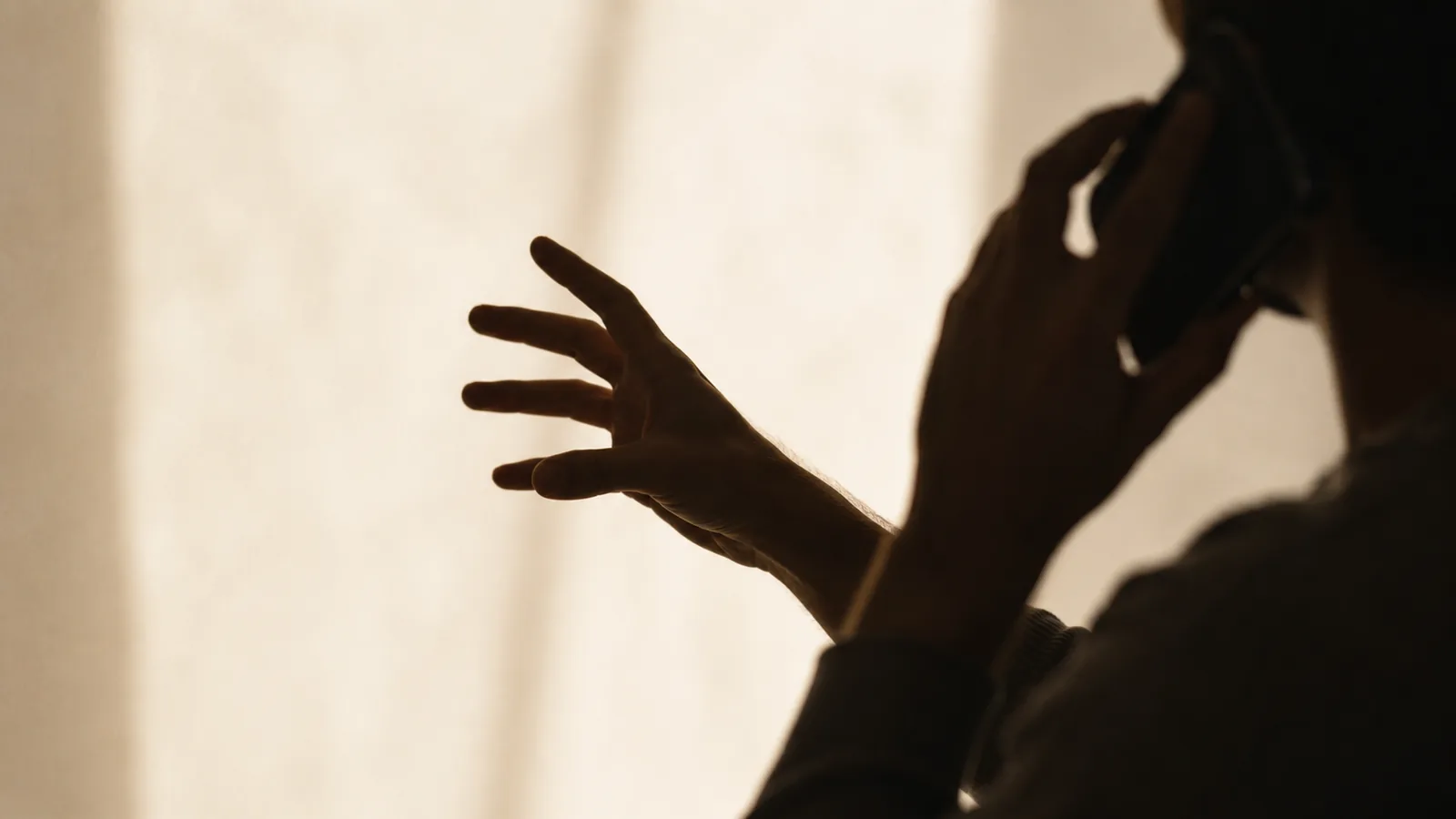
Gesturing on the phone looks like a wasted signal, and the evidence says it is not a signal at all — or not only one. Preventing people from gesturing measurably degrades their speech, particularly for spatial content, and increases word-finding difficulty. The strongest evidence comes from congenitally blind speakers, who gesture while talking to listeners they know are also blind.
That last finding is the one that settles the argument, because there is no communicative account under which it makes sense.
The blind speaker studies
Jana Iverson and Susan Goldin-Meadow examined gesture in people blind from birth, who had never seen anyone gesture and had no visual model to imitate.
They gestured anyway, at rates and in forms comparable to sighted speakers, and — critically — they continued to gesture when told their conversational partner was also blind. A speaker who knows with certainty that no one can see their hands still moves them.
If gesture were purely a message for the listener, this behaviour would be inexplicable. It follows straightforwardly if gesture is doing something for the speaker.
The timing gives it away
Co-speech gesture is tightly synchronised with the speech it accompanies, and the direction of that synchrony is informative. The meaningful part of a gesture — the stroke — tends to begin at or slightly before the word it relates to, rather than following it.
A gesture that were merely illustrating finished speech would have no reason to arrive first. Leading the word is what you would expect if hand movement and word retrieval are drawing on a shared preparatory process, with the manual channel simply reaching output sooner than the vocal one.
Gesture rate also varies substantially between cultures and individuals without tracking how much information needs conveying, which is a further argument against a purely communicative account.
What it does for the speaker
Two main accounts exist, and they are complementary rather than competing.
The lexical retrieval account, developed by Robert Krauss and colleagues, holds that gesture assists in accessing words. The supporting evidence is direct: when people are prevented from gesturing, their speech deteriorates most for content with spatial or motoric properties, and word-finding difficulties increase. One study found that restricting hand movement raised the rate of tip-of-the-tongue states — the specific failure mode you would predict if gesture were feeding activation into the retrieval process.
The conceptualisation account, associated with Sotaro Kita and colleagues, argues for something broader: gesture helps organise spatio-motoric information into the linear, segmented form that speech requires. On this view gesture is part of thinking the thought through, not just of finding the word for it.
Both make gesture part of the production machinery rather than an accompaniment to it, which is why it persists when nobody is receiving it — the same logic behind saying things out loud when no one is listening, where externalising the content changes the processing.
Gesture can carry what speech does not
The strongest evidence that gesture is part of thinking rather than decoration comes from cases where the hands and the mouth disagree.
Susan Goldin-Meadow's group studied children explaining how they solved mathematical equivalence problems. Some produced what the researchers called a gesture-speech mismatch: their spoken explanation gave one strategy while their hands simultaneously indicated a different one — often a more advanced strategy they could not yet articulate.
Those mismatching children turned out to be the ones on the verge of learning. They benefited more from subsequent instruction than children whose gesture and speech agreed. The hands were expressing knowledge that had not yet reached the point of being sayable, which is difficult to explain if gesture is merely an accompaniment to finished speech.
The practical corollary has been tested too: instruction that includes gesture, and encouraging learners to gesture, improves learning outcomes relative to speech alone. Gesture participates in the process on both sides of the exchange.
But it is also for the listener
The strong version — gesture is purely for the speaker — overshoots, and the evidence rules it out.
Gesture rate drops when the listener cannot see you. It does not vanish, but it reliably decreases, and the decrease is selective: representational gestures that depict content fall off, while beat gestures that mark rhythm and emphasis are largely unaffected.
That pattern is informative. The gestures carrying information for an audience are reduced when there is no audience to carry it to; the gestures tied to speech production continue regardless. Both functions are operating, and phone gesturing is the residue left when the communicative half is switched off.
Why some situations produce more
The prediction follows: phone gesturing should increase when speech is harder, and it does. Describing a route, explaining a spatial arrangement, recounting a physical action, or searching for a word all reliably produce more hand movement than casual conversation.
If you have ever caught yourself drawing a floor plan in the air for someone two hundred miles away, that is the retrieval and conceptualisation machinery running on a task it finds demanding, with no regard for the fact that the output is going nowhere.
A caution on the framing
Gesture research is often presented under the banner of embodied cognition, a framework holding that thought is grounded in bodily and sensorimotor processes rather than in abstract symbol manipulation.
The gesture findings are real and are consistent with that framework, but they do not establish it. Embodied cognition is a broad theoretical programme that has generated both robust results and a number of high-profile findings that failed to replicate. The specific claim here is narrow and well supported: hand movement participates in speech production. The larger claim it is often used to support is a different proposition with a more mixed record.
The narrow finding is interesting enough on its own. A behaviour that looks like a pointless social reflex turns out to be part of how you assemble the sentence, and it belongs with the other things people do for listeners who are not there — including dropping your voice in an empty dark room.
Same trick, different system
Frisson: Why Certain Songs Give You Goosebumps
Frequently asked questions
Gesture is part of speech production rather than only a message for the listener. Preventing people from gesturing degrades their speech, particularly for spatial content, and increases word-finding difficulty — so the hands are helping you talk, not the person hearing you.
Yes, including people blind from birth who have never seen anyone gesture. They gesture at comparable rates to sighted speakers and continue to do so when told their conversational partner is also blind, which rules out a purely communicative explanation.
The evidence suggests so. Restricting hand movement degrades speech containing spatial and motoric content, and one study found it increased the rate of tip-of-the-tongue states — the specific failure you would expect if gesture feeds activation into word retrieval.
Yes, but selectively. Representational gestures that depict content decrease when the listener cannot see, while beat gestures marking rhythm and emphasis are largely unaffected — indicating that gesture serves both communicative and speech-production functions.
It is consistent with that framework without establishing it. The narrow finding — that hand movement participates in speech production — is well supported. The broader theoretical programme it is often used to support has a considerably more mixed record.
This article is educational science trivia about everyday human biology and psychology. It is not medical advice, diagnosis, or treatment, and it is not a substitute for care from a qualified professional.