Why Mint Feels Cold When Nothing Cools Down
The thermometer does not move. The nerve reports cold anyway.

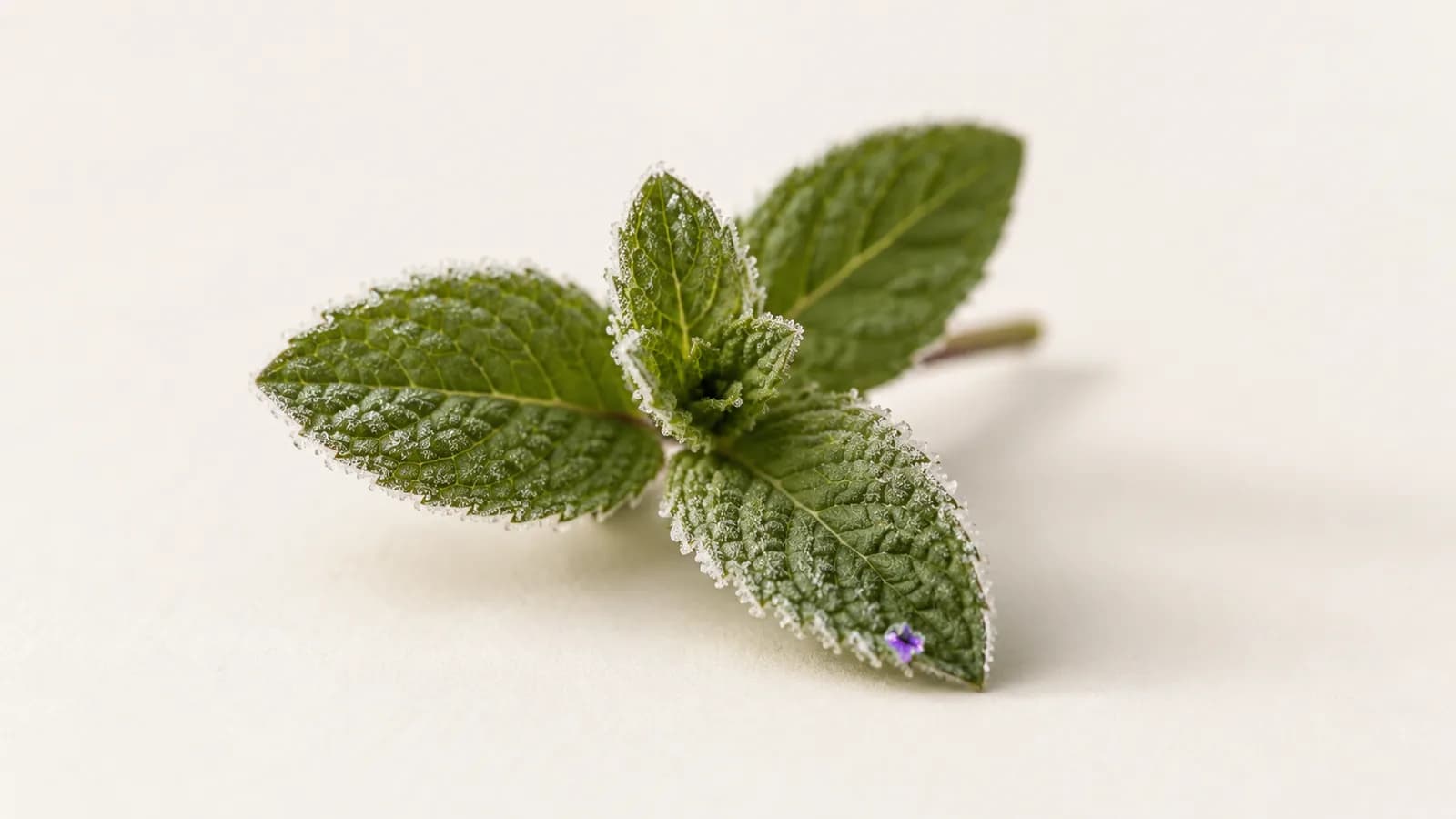
Menthol does not lower the temperature of anything. It binds to TRPM8, a receptor whose job is detecting cold, and opens it chemically — so your nerves report cold that is not happening. It is the exact mirror of what chilli does with heat, and the two receptors were identified by the same line of research.
Put a thermometer in your mouth after a strong mint and the reading does not move. The sensation is entirely a signalling event.
The receptor that gets fooled
TRPM8 sits in the membranes of sensory neurons, including trigeminal endings supplying the mouth, nose and eyes. It opens in response to temperatures below roughly 26°C, and the resulting signal is interpreted as cool.
Menthol binds directly to TRPM8 and opens the same channel. The receptor has no way to distinguish the source, so it reports what it always reports — cold at this location — and everything downstream follows.
This is precisely the arrangement behind chilli heat, with TRPV1 and capsaicin in place of TRPM8 and menthol. One plant compound opens the heat receptor; another opens the cold one. The two are mirror images at the molecular level.
Why it makes cold air feel colder
Menthol does not just open the channel — it shifts its activation threshold, making TRPM8 respond to temperatures it would otherwise ignore.
That produces the effect anyone who has breathed in after a strong mint will recognise. Ordinary room-temperature air becomes strikingly cold, because the receptors reporting on it have been sensitised. The air has not changed; the threshold for calling it cold has moved.
It also explains why the sensation outlasts the mint itself. Menthol is fat-soluble and lingers in the tissue, so the sensitisation persists for some minutes after the flavour has gone.
There is a further wrinkle worth knowing: TRPM8 is not purely a cold sensor. It is also implicated in cold hypersensitivity and has become a target of interest in pain research, which is a reminder that receptors named for one function frequently turn out to be doing several.
What TRPM8 is actually for
Being fooled by peppermint is not the receptor's purpose. TRPM8 is the primary molecular sensor for innocuous cold in mammals, and it is how you detect that a surface is cool rather than merely that it is not warm.
It was identified in 2002 by two independent groups, one of which was working on the same programme that had identified the capsaicin receptor five years earlier. David Julius, who led that work, shared the 2021 Nobel Prize in Physiology or Medicine for the discovery of receptors for temperature and touch.
So this is not an obscure corner of sensory biology. The chemistry of mint and chilli was the route by which the molecular basis of temperature sensation was worked out at all — the plants supplied the tools.
The dose-dependence is straightforward and easy to notice. A weak mint produces mild coolness; a strong one can be genuinely uncomfortable, and very high concentrations of menthol produce a burning sensation rather than a cooling one — because at that level it begins activating other receptors alongside TRPM8.
Not all cooling compounds are menthol
Menthol is the best-known TRPM8 agonist but not the only one. Eucalyptol, found in eucalyptus, produces a milder version, and the food industry uses synthetic cooling agents such as WS-3 and WS-23 that trigger the same receptor with less of menthol's characteristic smell.
That separation is commercially useful and mechanistically informative. Cooling and mintiness are not the same property — one is receptor activation, the other is olfactory. A compound can deliver the first without the second, which is why some chewing gums feel intensely cold without tasting strongly of mint.
It also rules out a tempting alternative explanation. If the cold sensation came from the smell or from evaporation in the mouth, an odourless synthetic agonist would not produce it. It does.
Why menthol is in so many products
The commercial applications follow directly from the mechanism, and some are more defensible than others.
In toothpaste, chewing gum and mouthwash, the cooling sensation reads as cleanliness and freshness. That association is learned rather than intrinsic — there is nothing about cold that indicates a clean mouth — but it is now firmly established.
Topical menthol preparations for aches work partly through counterirritation: a strong non-painful sensation competes with pain signalling at the spinal level, the same gate control principle behind rubbing a bump. The cooling is real as sensation; nothing is being cooled or treated.
Menthol in cigarettes exploits the mechanism more consequentially. The cooling and mild anaesthetic effect reduce the harshness of smoke, which makes inhalation easier — a well-documented reason menthol cigarettes have attracted regulatory attention in several countries.
There is a neat symmetry in how the two compounds behave over time as well. Repeated capsaicin exposure desensitises TRPV1, which is why chilli tolerance builds. Menthol does not produce the same durable desensitisation, which is part of why mint does not become less minty with use in the way chilli becomes less hot.
The pattern this belongs to
Sensation is not a readout of the world. It is the output of receptors that respond to specific molecular events, and anything producing the same event produces the same sensation regardless of what is physically true.
Once you see that, a set of otherwise unrelated experiences line up. Chilli burns nothing. Mint cools nothing. And the pain of brain freeze appears in a forehead where nothing is happening at all, because the trigeminal system misreported the location.
Three different failures — wrong cause, wrong cause, wrong place — all in the same nerve, all producing experiences that feel entirely authoritative from the inside.
Same trick, different system
Micro-Expressions: The Half-Second Face You Can’t Control
Frequently asked questions
Menthol binds to TRPM8, the receptor that detects cold temperatures, and opens it chemically. Your nerves report cold even though nothing has cooled — the exact mirror of capsaicin opening the heat receptor TRPV1.
No. A thermometer shows no change. The entire sensation is a signalling event in which a temperature receptor is opened by a chemical rather than by temperature.
Menthol shifts TRPM8's activation threshold, so the receptor responds to temperatures it would normally ignore. Room-temperature air then registers as cold because the sensitivity has moved, not the air.
Several minutes beyond the flavour, because menthol is fat-soluble and lingers in the tissue. The receptors stay sensitised after the taste has faded.
The cooling and mild anaesthetic effect reduces the harshness of smoke and makes inhalation easier. This is a well-documented reason menthol cigarettes have attracted regulatory attention in several countries.
No. Eucalyptol produces a milder version, and the food industry uses synthetic agonists such as WS-3 and WS-23 that trigger the same receptor with far less minty smell — which shows cooling and mintiness are separate properties.
At high concentrations menthol begins activating receptors beyond TRPM8, so the sensation shifts from cooling toward burning. The effect is dose-dependent rather than a fixed property of the compound.
This article is educational science trivia about everyday human biology and psychology. It is not medical advice, diagnosis, or treatment, and it is not a substitute for care from a qualified professional.