Why Onions Make You Cry (and Why the Fridge Trick Works)
The onion isn’t attacking your eyes. It’s defending itself, and you walked into it.

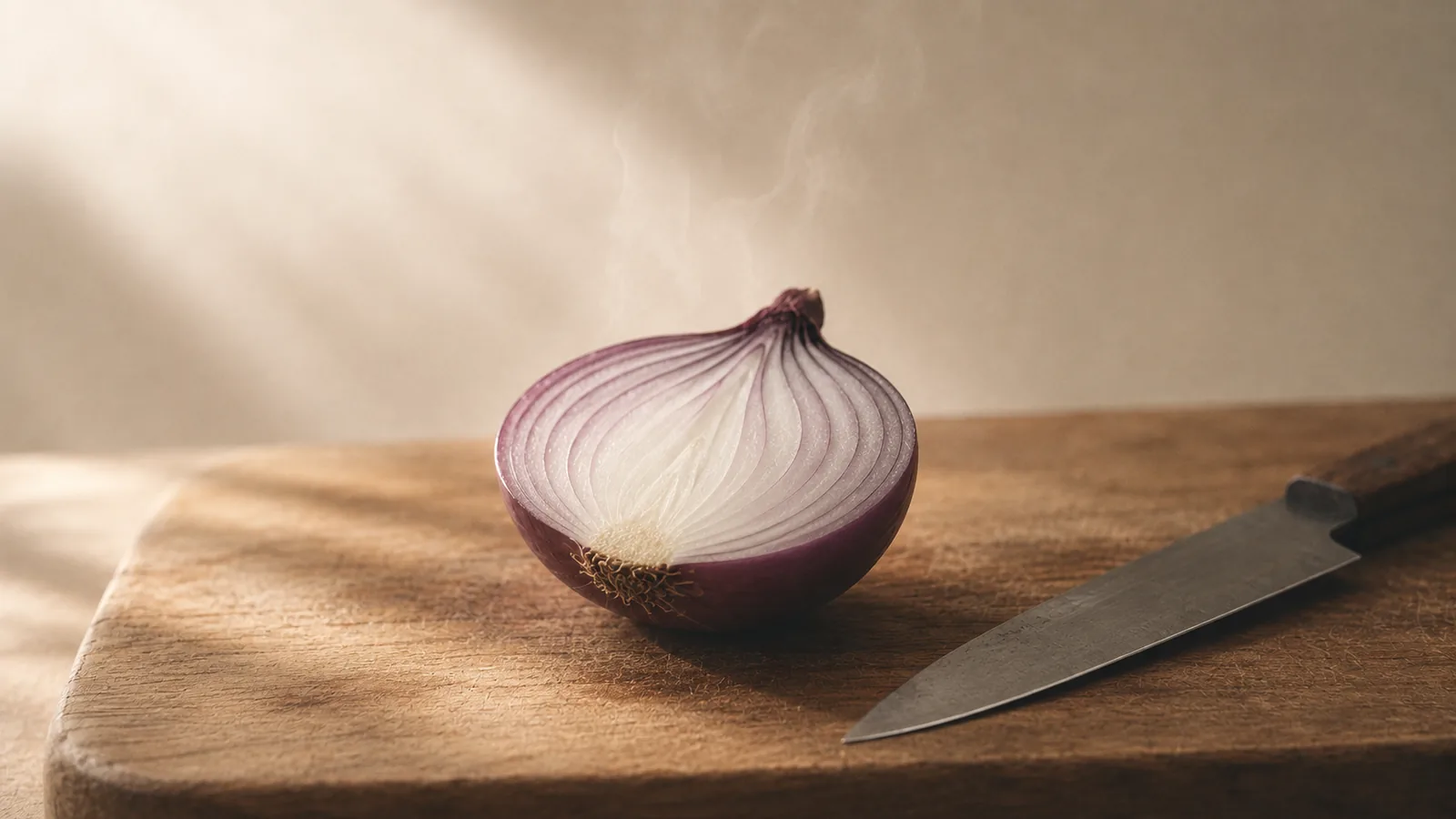
An intact onion is harmless. Cutting one ruptures cell compartments that are normally kept apart, triggering a two-enzyme reaction that manufactures a volatile sulfur compound called syn-propanethial-S-oxide within seconds. It reaches your cornea, irritates the trigeminal nerve endings there, and your eye responds by flushing. The onion is not attacking you — it is defending itself, and you have walked into the defence.
The chemistry is one of the better-resolved things on this site, and it was corrected surprisingly recently: the accepted mechanism changed in 2002.
A chemical weapon assembled on demand
The key point is that the irritant does not exist in an intact onion. What the onion stores is a precursor and, separately, an enzyme — kept in different cellular compartments so they never meet.
The precursor is isoalliin, an amino acid derivative properly called trans-S-1-propenyl-L-cysteine sulfoxide, sitting in the cytoplasm. The enzyme is alliinase, held in the vacuole. Both are stable and odourless while separated.
Cut the onion and you rupture the compartments. Alliinase meets isoalliin and cleaves it, producing 1-propenylsulfenic acid, a highly reactive and short-lived intermediate. This is a binary weapon: two harmless components, mixed only by the act of an animal biting or cutting into the tissue.
This defends against exactly the threat it needs to. An animal that takes a bite gets a face full of irritant; an onion left alone in the ground produces nothing at all.
The enzyme nobody knew about
For decades, chemists believed the sulfenic acid spontaneously rearranged into the tear-inducing compound — an unassisted chemical step requiring no further help.
In 2002, Shinsuke Imai and colleagues showed that this was wrong. Working with crude onion protein preparations, they found that the ability to form the lachrymatory factor could be separated from alliinase activity entirely, which meant a second enzyme was doing it. They named it lachrymatory factor synthase, and reported the finding in Nature.
LFS converts 1-propenylsulfenic acid into (Z)-propanethial S-oxide — syn-propanethial-S-oxide, the actual lachrymator. It is small, volatile, and reaches your face within seconds of the knife going in.
This mattered beyond tidiness. A spontaneous rearrangement is not a target; an enzyme is. The discovery made a tearless onion a tractable engineering problem for the first time.
What happens at your eye
The compound is volatile enough to reach the cornea in a plume from the cutting board. The cornea is one of the most densely innervated tissues in the body, supplied by the trigeminal nerve, and it is exquisitely sensitive to chemical irritation.
The irritant activates those nerve endings, and the trigeminal signal triggers a reflex: sharply increased tear production to dilute and flush the offending substance off the eye surface. Blinking increases, and the eyes may close involuntarily. Reflex tearing has a purely mechanical cousin with no irritant involved at all — the tears a deep yawn squeezes out.
These are reflex tears, produced through a completely different route from the emotional kind. The distinction is not merely categorical — emotional tears appear to be uniquely human and serve a social signalling function, while reflex tearing is a protective mechanism shared broadly across mammals. The onion produces the second and none of the first.
It is also the same defensive strategy behind chilli heat: a plant compound activating trigeminal receptors to produce a defensive reflex, in one case at the eye and in the other in the mouth and nasal cavity.
Why garlic does not do this
Garlic is a close relative with the same general chemistry — cysteine sulfoxide precursors, alliinase, a violent enzymatic response to being cut — and it does not make you cry.
The difference is in the precursor and the missing enzyme. Garlic's principal precursor is alliin, which alliinase converts to allyl sulfenic acid and thence to allicin, responsible for garlic's pungency and much of its reputed biological activity. Garlic lacks the lachrymatory factor synthase step, and its sulfenic acid does not have the chemical structure that yields a volatile lachrymator in any case.
So the two plants run the same defensive strategy with different payloads: garlic produces a compound that is unpleasant in the mouth, onion one that is unpleasant in the eyes. The tear-inducing capacity is not a general feature of the genus but a specific elaboration in onion and a handful of relatives.
The tearless onion
Once LFS was identified, two routes opened. In 2008 a New Zealand group silenced the LFS gene using RNA interference and confirmed the effect — with an interesting side result. Blocking the enzyme does not remove the sulfenic acid; it redirects it, so more converts spontaneously into di-1-propenyl thiosulfinate and downstream compounds, some of which had barely been detected in onions before.
A non-transgenic route followed. A Japanese group irradiated onion seeds with neon ions, screened successive generations for tear induction, and produced tearless, non-pungent bulbs with lachrymatory factor levels around seven and a half times lower than normal onions.
Worth noting: existing sweet onion cultivars achieve mildness by a completely different route — reduced sulfur uptake, often through cultivation in sulfur-poor soil — which lowers the whole family of sulfur compounds rather than the single enzyme, and takes flavour with it.
Which kitchen tricks actually follow
The mechanism predicts what should help, and most of the folk advice divides cleanly into justified and not.
- A sharp knife: fewer ruptured cells per cut means less enzyme-substrate mixing. Directly implied by the mechanism.
- Chilling the onion: lower temperature reduces volatility, so less of the compound reaches your face. Also reduces enzyme activity.
- Cutting near running water or under extraction: removes the plume before it arrives. Addresses transport rather than production.
- Leaving the root end intact until last: sulfur compounds are most concentrated toward the base.
- Goggles: unglamorous and the only method that addresses the actual point of contact.
- Bread in the mouth, holding a spoon, breathing through the mouth: no mechanism, and no evidence.
The pattern is that anything reducing cell damage, volatility or delivery has a basis, and anything involving your mouth does not — the compound is reaching your eyes through the air, and what you are doing with your tongue is irrelevant to it.
Same trick, different system
Earworms: Why Songs Get Stuck in Your Head (and How They Leave)
Frequently asked questions
Cutting ruptures cell compartments, letting the enzyme alliinase meet its precursor and produce a reactive intermediate, which a second enzyme converts into volatile syn-propanethial-S-oxide. This reaches your cornea, irritates trigeminal nerve endings, and triggers reflex tearing.
It reduces them. Lower temperature decreases the volatility of the irritant so less reaches your face, and also slows the enzymes producing it. It is one of the few kitchen tricks with a clear mechanistic basis.
A sharp blade ruptures fewer cells per cut than a blunt one that crushes tissue. Less cell damage means less mixing of enzyme and precursor, and therefore less irritant produced in the first place.
Yes, by two routes. One group silenced the lachrymatory factor synthase gene using RNA interference; another irradiated seeds and screened for the trait non-transgenically, producing bulbs with roughly seven-fold lower lachrymatory factor.
No. Onion tears are reflex tears, a protective flush triggered by chemical irritation of the cornea and shared broadly across mammals. Emotional tears are produced through a different pathway and appear to be uniquely human.
This article is educational science trivia about everyday human biology and psychology. It is not medical advice, diagnosis, or treatment, and it is not a substitute for care from a qualified professional.