Change Blindness: Why You Don't Notice the Person Swapping Mid-Conversation
Half the participants finished giving directions to a completely different person.

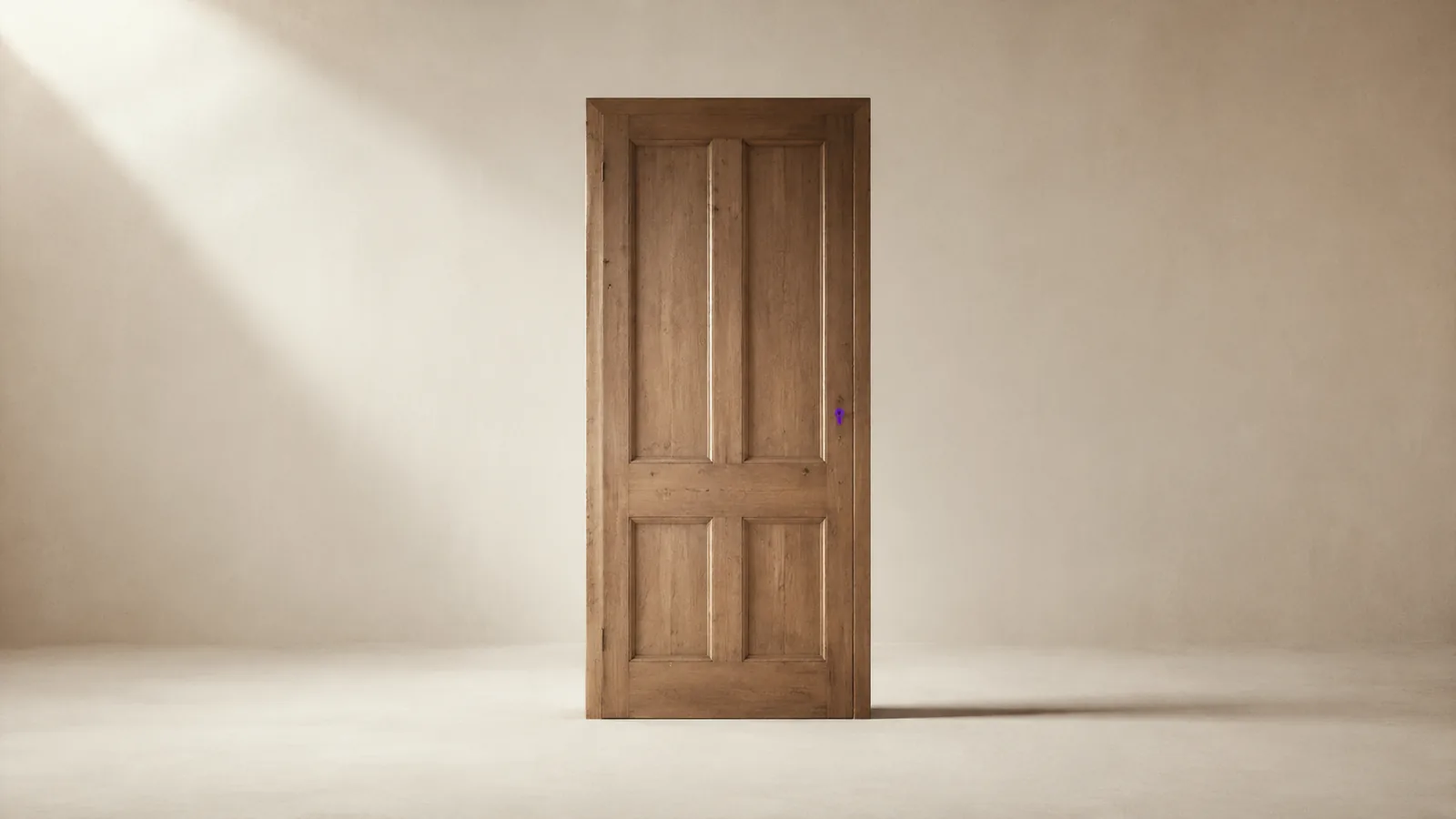
In one experiment, a stranger asking for directions was swapped mid-conversation for a different person — different clothes, different height, different voice — while two workmen carried a door between them. Around half the participants carried on talking without noticing. Change blindness is the failure to detect a difference between two moments, and it happens because you never stored the first moment in the detail you assume you did.
The instinct is that you would obviously notice. That instinct is itself the finding, and it has a name: change blindness blindness — people systematically overestimate their own ability to detect changes.
The door study
Daniel Simons and Daniel Levin ran the best-known version on a university campus in 1998. An experimenter approached a pedestrian to ask for directions. Mid-conversation, two people carrying a large door walked rudely between them.
Under cover of the door, the first experimenter swapped places with a second, who then continued the conversation. The two differed in height, build, clothing and voice.
Around half of participants continued giving directions without registering that they were now speaking to a different person. Several, when told afterwards, refused to believe it until shown the video.
Why you can miss something that large
The intuition being violated is that vision produces a detailed internal picture of the scene, held in memory and available for comparison. It does not.
What you retain from one moment to the next is a sparse summary — the gist, plus whatever you attended to specifically. When the scene changes, there is nothing detailed enough to compare against, so no discrepancy is flagged.
This is why the door matters. A change made in full view produces a motion signal that captures attention automatically, and almost everyone notices. Hide the transition behind an interruption — a door, a cut in a film, a blink, a flicker — and the automatic alarm never fires. The change has to be found by deliberate comparison, and there is nothing stored to compare with.
This makes change blindness a distinct failure from missing a gorilla in a scene you are watching. That one is a detection failure within a single moment. This one is a comparison failure across two.
The laboratory version
The door study is memorable but hard to run at scale. Most research uses the flicker paradigm, developed by Ronald Rensink and colleagues: two versions of a photograph alternate, separated by a brief blank frame.
Without the blank, the change is obvious — the motion signal gives it away instantly. Insert an eightieth of a second of grey and viewers can take many seconds to find an alteration covering a substantial part of the image. Aircraft engines vanish. Buildings change height. Railings appear.
A variant makes the point even more economically. Instead of blanking the whole screen, small splashes of colour are flashed across the image, like mud on a windscreen. They do not cover the change. They simply create competing motion signals, and that alone is enough to hide it.
That result rules out a comfortable explanation. The change is not missed because it was obscured — it is missed because the signal that would normally announce it has been drowned out.
Where it shows up
- Continuity errors in films, which survive multiple professional reviews and are only spotted by audiences looking specifically for them.
- Flicker paradigms in the laboratory, where two versions of an image alternate with a blank frame between them and large changes take viewers many seconds to find.
- Driving, where a hazard that appears during a glance away is far less likely to be registered than one that appears in view.
- Interface design, where a change made during a page transition frequently goes unnoticed — occasionally by deliberate design.
Film gives the effect a permanent home. Continuity errors survive shooting, editing, review by several professionals and often a director's commentary, then get catalogued by audiences watching for them specifically. A glass empties and refills between cuts; a jacket changes; a car repairs itself. Nobody in the production missed them through carelessness. The cut hides the change exactly as the door did.
The overreach worth resisting
Change blindness is often presented as proof that vision is an illusion, or that we see almost nothing of the world. That goes too far.
What the research shows is that detailed visual information is not retained across interruptions, not that it is never processed. While you are looking, you have rich access to the scene. The limitation is in what persists once you look away, and in what gets compared when you look back.
The other frequent leap is to eyewitness reliability. The connection is real but weaker than usually implied — these are staged changes under specific conditions, and the distance between a door-swap experiment and a courtroom is considerable.
The same caution applies to reading faces: people register far less of an expression than they assume, which is part of why claims about detecting concealed emotion perform so badly.
What it says about ordinary seeing
The useful conclusion is not that perception is unreliable. It is that the sense of having a complete, detailed picture in mind is manufactured — you experience a full scene because you can look at any part of it and get detail on demand, not because the detail is being held.
That works almost all the time. It fails specifically when something changes while you are not looking at it, which in ordinary life is rare and in a laboratory is trivially easy to arrange.
Which is why change blindness feels shocking and is not, in itself, a problem. The system is not broken. It is running an economical strategy that has one predictable failure mode, and psychologists have built a very effective party trick out of it.
Same trick, different system
The Dunning-Kruger Effect: What It Actually Says
Frequently asked questions
The failure to notice a difference between two moments — a person, object or detail changing during an interruption such as a blink, a film cut, or something passing in front of you. It happens because the first moment was never stored in enough detail to compare against.
A 1998 experiment in which someone asking for directions was swapped for a different person while two workmen carried a door between them. Around half of participants continued the conversation without noticing, despite differences in height, build, clothing and voice.
Vision does not store a detailed internal picture across interruptions. You retain a sparse summary plus whatever you attended to. A change made in full view creates a motion signal that captures attention; a change hidden behind an interruption does not.
That overstates it. Detailed information is processed while you are looking; the limitation is in what persists once you look away. The sense of holding a complete picture is manufactured, but the access to detail on demand is real.
Inattentional blindness is failing to detect an object present in a single scene while attention is elsewhere. Change blindness is failing to detect that something differs between two moments — a comparison failure rather than a detection failure.
This article is educational science trivia about everyday human biology and psychology. It is not medical advice, diagnosis, or treatment, and it is not a substitute for care from a qualified professional.