Micro-Expressions: The Half-Second Face You Can’t Control
A real expression can cross your face in a twentieth of a second. Cameras catch it. People usually don’t.

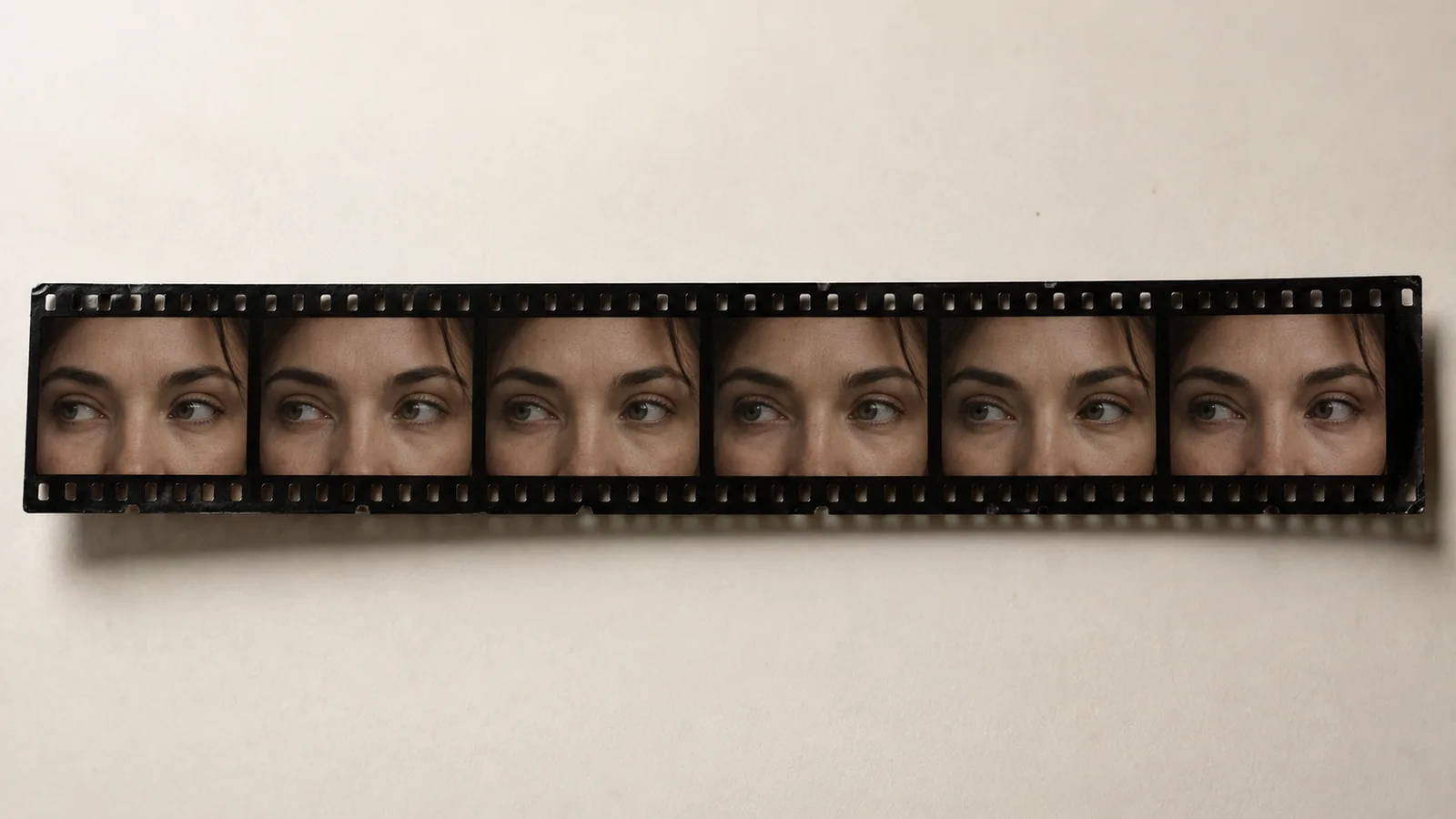
A micro-expression is a brief involuntary facial movement, lasting a fraction of a second, thought to leak an emotion someone is trying to conceal. They exist and can be measured. What the evidence does not support is the industry built on top of them: in the main production study, micro-expressions appeared in around 2 percent of expressions, and when they did occur they failed to distinguish liars from truth-tellers.
This is the most commercially consequential claim in body language, sold as training to police forces, airport security and interviewers. It deserves to be separated carefully into the part that is a measurement and the part that is an inference.
Where the idea came from
The observation dates to the 1960s, when Haggard and Isaacs described what they called micromomentary facial expressions in psychotherapy footage. Paul Ekman and Wallace Friesen developed it into a theory of nonverbal leakage in 1969: that concealed emotion escapes briefly through the face before voluntary control reasserts itself.
Ekman and Friesen also produced the Facial Action Coding System, which catalogues facial movements as discrete action units corresponding to individual muscle actions. FACS is a genuine achievement and remains a standard research tool. It provides an objective way to describe what a face is doing.
Note the distinction carefully, because almost all the confusion lives here. FACS describes movement. It does not tell you what the movement means, and the leap from one to the other is where the evidence thins out.
What the production studies actually found
For a long time the claim rested on unpublished proprietary data. The most substantial independent test came from Stephen Porter and Leanne ten Brinke in 2008, who coded 697 facial expressions across 104,550 video frames from participants responding to emotional images with either genuine or falsified expressions.
Micro-expressions were found in only about 2 percent of all expressions, produced by roughly 22 percent of participants — and they appeared during honest responses as well as deceptive ones. Subsequent analyses of that dataset and related ones found that when micro-expressions did occur, they did not distinguish truthful from deceptive responses.
So the phenomenon is real and rare, and its diagnostic value for deception has not been demonstrated. It is worth noticing how easily a rare, ambiguous signal becomes evidence for whatever an observer already suspects — the same over-eager pattern detection that finds a face in a wall socket will find guilt in a twitch.
The training tools
Commercial training claims to teach micro-expression recognition, and on its own terms it works: participants improve substantially at labelling briefly presented emotional expressions. The question is whether that transfers to the task people buy it for.
A 2019 test of the micro-expressions training tool examined precisely this and found that improved recognition did not translate into improved lie detection. That is the finding that matters, and it is the one least often quoted in marketing material.
The background rate makes it starker. The most-cited meta-analysis, covering roughly 25,000 participants, puts human accuracy at detecting deception at about 54 percent — barely above chance. Any training claim has to be measured against how little room there is at the bottom.
The airport programme
The United States Transportation Security Administration ran a behaviour-detection programme built on this family of assumptions. A Government Accountability Office review concluded that the available evidence did not support the scientific validity of behavioural indicators for identifying threats, and recommended against continued funding at existing levels. It is the largest real-world test the idea has had.
The deeper problem: do expressions map onto emotions at all?
Micro-expression reading inherits an assumption from basic emotion theory — that specific facial configurations correspond to specific emotional states, universally. That assumption is now seriously contested.
The original cross-cultural evidence came from Ekman and Friesen's studies with the Fore people of Papua New Guinea. Methodological critiques, most influentially from James Russell, argued that the forced-choice format cued participants toward expected answers. When later researchers used free labelling with the Himba of Namibia rather than supplying a list of emotion words, the neat correspondences largely dissolved.
In 2019 Lisa Feldman Barrett and colleagues published a large review in Psychological Science in the Public Interest concluding that facial configurations are not reliable diagnostic indicators of emotional state — that people move their faces in highly variable ways for a given emotion, and produce the same configuration in the absence of it. Scowling is not a reliable readout of anger; people scowl when angry only some of the time, and scowl frequently when they are not.
This is a live argument rather than a closed case. Researchers including David Matsumoto have published work reporting that micro-expressions differentiate truthful from deceptive statements about future intent under some operationalisations, and proponents dispute the reach of the sceptical reviews. Reported here as an unresolved dispute, which is what it is.
What faces are actually good for
One experiment makes the context point better than any argument. Hillel Aviezer, Yaacov Trope and Alexander Todorov collected photographs of professional tennis players in the instant after winning or losing a crucial point — real, intense, unposed emotion at the extremes of both valences.
Shown the faces alone, participants could not tell winners from losers; performance was at chance. Shown the bodies alone, they judged accurately. And when the researchers swapped faces between winning and losing bodies, participants' judgements followed the body — while continuing to report that they had read the emotion from the face.
That is a strong result and it should reframe the whole enterprise. At peak intensity the face is not a readable signal in isolation, people are demonstrably wrong about where their own judgements come from, and the surrounding context is doing work the observer does not notice.
What you can reasonably conclude
- Brief involuntary facial movements exist and can be coded objectively with FACS.
- They are rare in the settings where they have been measured, appearing in a small percentage of expressions.
- They occur during honest communication as well as deceptive communication.
- Training improves emotion labelling without improving lie detection.
- The assumption that a facial configuration reliably indicates a specific emotion is contested by a substantial body of recent work.
None of which makes faces uninformative. It makes single-cue reading unreliable, which is the same conclusion that applies to almost every claim in this genre — including the belief that crossed arms mean defensiveness. Expressions carry information in context, in clusters, and over time. A twentieth of a second of one eyebrow does not.
Same trick, different system
Why Mint Feels Cold When Nothing Cools Down
Frequently asked questions
The evidence does not support it. In the main independent production study, micro-expressions appeared in around 2 percent of expressions, occurred during honest responses too, and did not distinguish deceptive from truthful ones.
It improves the specific skill it trains — labelling briefly presented expressions — but a 2019 test found this did not translate into better lie detection. Human deception-detection accuracy sits at roughly 54 percent, close to chance.
This is contested. The original cross-cultural studies used forced-choice formats that critics argue cued participants toward expected answers, and free-labelling studies with other populations produced different results. A 2019 review concluded facial configurations are not reliable diagnostic indicators of emotion.
The Facial Action Coding System catalogues facial movements as discrete action units corresponding to muscle actions. It is a well-established descriptive tool and remains standard in research. The disputed step is inferring specific emotions or deception from the movements it records.
Definitions vary, typically from around a twenty-fifth of a second up to about half a second. The variation in operational definitions is itself part of why findings across studies are difficult to compare.
This article is educational science trivia about everyday human biology and psychology. It is not medical advice, diagnosis, or treatment, and it is not a substitute for care from a qualified professional.