The Moon Illusion: Why the Moon Looks Huge on the Horizon
Photograph both and the discs match. After 2,000 years, nobody can say why one looks bigger.

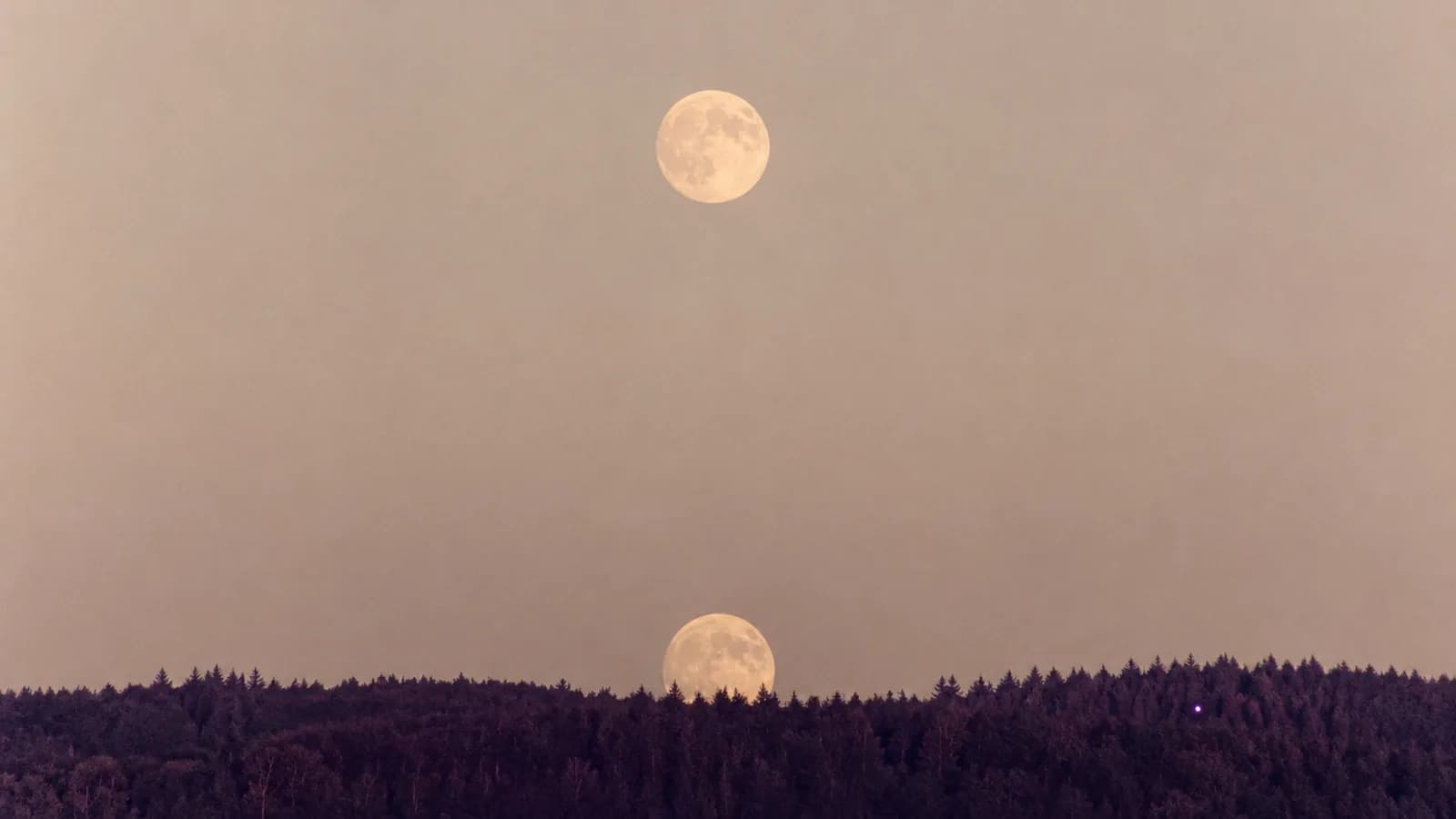
The moon looks dramatically larger near the horizon than overhead. It is not. Photograph both and the discs measure the same — if anything the horizon moon is very slightly smaller, because it is further from you. After more than two thousand years of investigation, there is still no agreed explanation, which makes this one of the oldest unsolved problems in perception.
Most articles on this present a confident answer. The honest position is that several accounts compete, each explains part of the evidence, and none has won.
First, what it definitely is not
The explanation most people are given is atmospheric magnification — that air near the horizon acts as a lens and enlarges the moon. This is straightforwardly wrong and has been known to be wrong for centuries.
The moon's angular size can be measured. Hold out a small object at arm's length, or photograph the moon with a fixed lens at both positions, and the disc is the same size in both images. Atmospheric refraction does have an effect, and it acts in the opposite direction — it slightly flattens the moon vertically near the horizon.
Geometry pushes the same way. When the moon is on the horizon you are roughly one Earth radius further from it than when it is overhead, making it marginally smaller, not larger.
So the illusion is entirely perceptual. Nothing about the light arriving at your eye differs in the way your experience suggests — which puts it in the same category as seeing a face in an electrical socket. Perception is inference, and inference can be wrong in a stable, repeatable way.
How old the question is
Aristotle discussed it. Ptolemy proposed an explanation in the second century. Alhazen refined one in the eleventh. Descartes, Berkeley and Helmholtz all had views.
The persistence is itself informative. This is not an obscure edge case awaiting a modern instrument — it is a phenomenon anyone can observe, that has attracted serious attention for two millennia, and that has resisted all of it.
The main competing accounts
Three explanations dominate the modern literature, and they are not fully compatible.
Apparent distance
The oldest surviving idea, developed most carefully by Lloyd Kaufman and Irvin Rock. The sky is not perceived as a hemisphere but as a flattened dome — the horizon seems further away than the zenith, because terrain between you and it supplies distance cues that empty sky does not.
If two objects cast the same retinal image but one is judged more distant, the more distant one must be physically larger. So the horizon moon is scaled up. Kaufman and his son later reported experimental support using a stereoscopic apparatus that let observers set the moon's apparent distance directly.
The objection is intuitive and persistent: asked directly, most people say the horizon moon looks closer, not further. Defenders argue the distance judgement operates below the level people can report, which is a coherent answer and also a difficult one to test.
Angular size contrast
A simpler proposal. Near the horizon the moon is surrounded by trees, buildings and terrain, all of which subtend small visual angles. Overhead it sits in an empty field. A disc surrounded by small things looks larger than the same disc surrounded by nothing — the Ebbinghaus illusion, essentially, applied to the sky.
This handles the fact that the illusion weakens when the horizon is featureless, such as over open sea. It struggles to explain reports of the illusion by pilots and in conditions with no reference objects at all.
Oculomotor factors
A third family points at the eyes and head rather than the scene. Looking upward involves different eye position and convergence, and changes in convergence are known to alter perceived size. Some versions predict the illusion should reverse when observers view the horizon moon while lying down or bending to look between their legs — a manoeuvre that has been reported to reduce it.
Why it stays unresolved
Partly because the effect is hard to measure. Perceived size has to be reported by comparison or matching, and different methods give different answers — some produce a large illusion, others almost none, for the same observer.
Partly because the accounts are not mutually exclusive. It is entirely plausible that distance cues, size contrast and eye position all contribute in proportions that vary with the scene, which would explain why every experiment supports some accounts and contradicts others.
And partly because the illusion is not one thing. Its strength varies between observers, between locations and between viewing methods, in a way a single clean mechanism would not predict.
There is no shame in this. Yawning is universal, occurs several times a day, and its function is also genuinely unsettled. Familiarity is not the same as being understood.
It is not only the moon
The same illusion applies to the sun and to constellations, which rules out anything specific to lunar appearance — brightness, colour, or the surface features people sometimes invoke.
It can also be produced artificially. Present a disc against a scene with strong distance cues and it looks larger than the identical disc against an empty field, indoors, with no atmosphere involved at all.
That generality is what makes the phenomenon interesting rather than trivial. Whatever is happening is a general property of how size is computed from an image, and the moon just happens to be the demonstration everybody has access to.
How to break the illusion yourself
Two methods work reliably and both are worth doing once, because the effect of removing the illusion is more striking than the illusion itself.
Look at the horizon moon through a tube — a rolled sheet of paper is enough. Stripping away the surrounding terrain collapses the apparent size immediately. Or bend over and view it upside down between your legs, which is undignified, well documented, and effective.
Neither tells you which theory is right. They do tell you the moon was never the variable.
Same trick, different system
Why Do We Blush? The Only Expression You Can’t Fake
Frequently asked questions
Nobody knows for certain. The disc is the same size in both positions, so the effect is purely perceptual. The main competing explanations involve apparent distance, size contrast with surrounding objects, and eye position — none of which has been established.
No — the opposite. When the moon is on the horizon you are roughly one Earth radius further from it than when it is overhead, making its angular size marginally smaller rather than larger.
No. This is the most common explanation and it is wrong. Atmospheric refraction slightly flattens the moon vertically near the horizon; it does not enlarge it. A photograph taken with a fixed lens shows identical disc sizes.
View the horizon moon through a tube such as a rolled sheet of paper, which removes the surrounding terrain, or look at it upside down by bending over. Both reliably reduce or eliminate the effect.
More than two thousand years. Aristotle discussed it, Ptolemy proposed an explanation in the second century, and Alhazen refined one in the eleventh. It remains one of the oldest unresolved problems in perception.
This article is educational science trivia about everyday human biology and psychology. It is not medical advice, diagnosis, or treatment, and it is not a substitute for care from a qualified professional.