Sleep Talking: What’s Actually Happening When You Talk in Your Sleep
Sleep talkers rarely say anything meaningful. What they say instead is far more interesting.

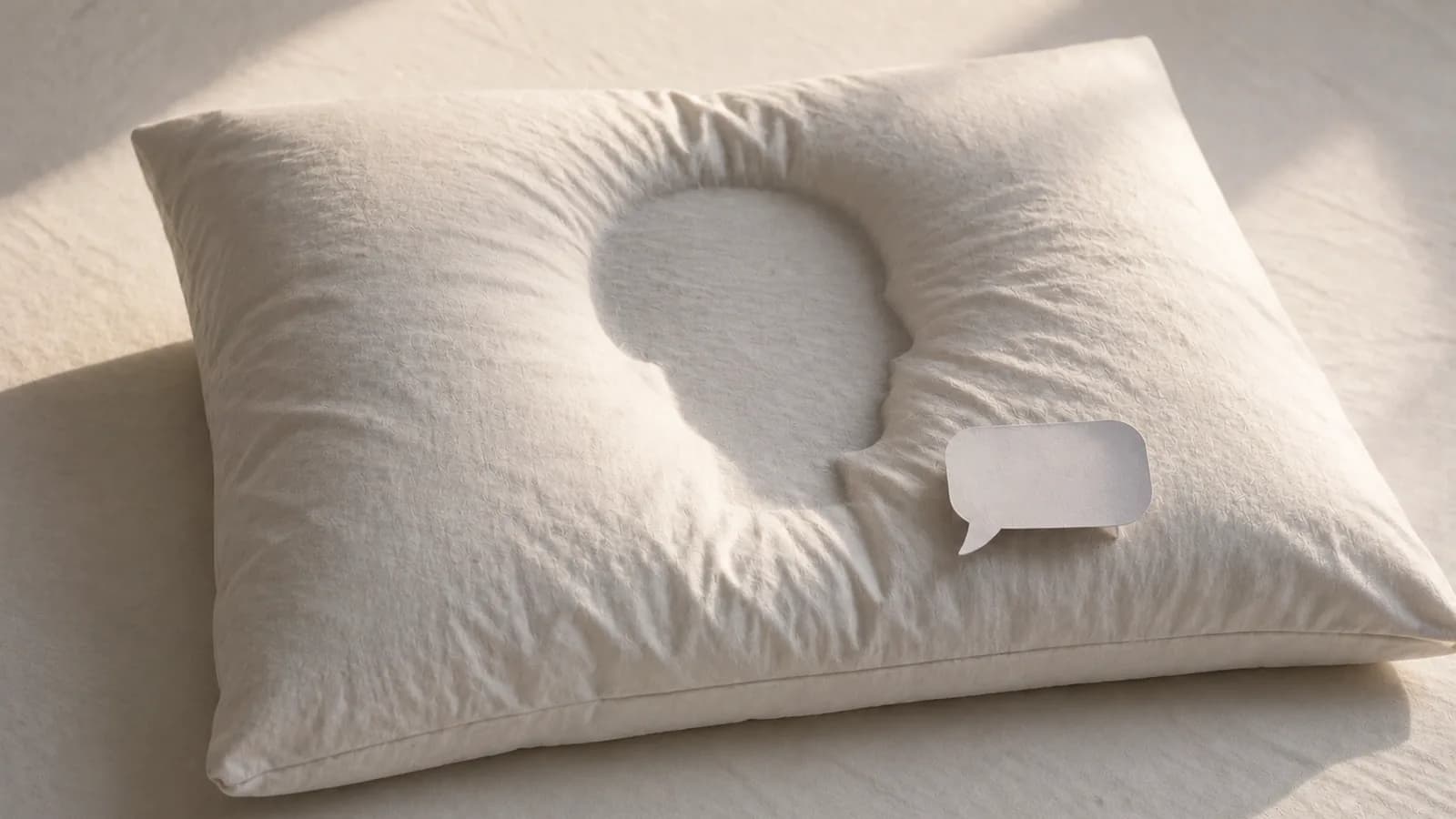
Sleep talking is speech that escapes during a partial arousal, when the mechanisms normally suppressing motor output during sleep briefly fail. The largest linguistic study of it found sleep speech closely follows waking grammar — including pauses left for an imaginary partner to reply — but it is not a window into secrets. It is mostly negative, frequently argumentative, and the single most common word is "no."
The folk belief that a sleeping person will answer honestly if you question them has survived a long time on no evidence at all. What the recordings actually show is stranger and less useful than the myth.
How common it is
Somniloquy is one of the most widespread parasomnias. More than two thirds of people report having spoken during sleep at some point, while around 5 percent of adults do it regularly. It becomes more likely during stress, fever and sleep deprivation, and it clusters in families.
Most of it is not speech in any full sense. It is closer to noise with structure.
What the sleeping brain actually says
The reference study came out of Isabelle Arnulf's group at the Pitié-Salpêtrière in Paris in 2017, and it remains the most rigorous linguistic analysis of sleep speech available. Using overnight video-polysomnography on 232 adults, the team captured 883 speech episodes containing 3,349 decipherable words.
The first finding is that most sleep talking is not verbal at all: 59 percent of episodes were mumbles, whispers, shouts or laughter with no recoverable words. The second is what the remainder contained. The most frequent single word was "no." Negations made up around a fifth of clauses. Roughly a quarter of episodes contained a question. About one clause in ten contained a profanity.
The third finding is the one that should be surprising. The speech was grammatically intact — the great majority of episodes were well formed, and around one in eight contained subordinate clauses, which is a genuinely demanding construction. Speakers also left pauses of roughly conversational length, as if waiting for someone to answer.
That last detail is the most informative thing in the study. Turn-taking is not a property of language you would expect to survive into sleep. Its persistence suggests that the networks handling speech production and conversational structure remain connected and functional while the systems that normally keep them offline are down.
The caveat that changes how you should read all of that
Sleep talking is rare enough on any given night that studying it in unselected sleepers is impractical. So the sample was weighted toward people who do it often: 92 percent had a parasomnia — most commonly REM sleep behaviour disorder or sleepwalking and sleep terrors — and only fifteen participants were healthy sleepers.
That was a reasonable design decision and it does not make the findings wrong. It does mean that extrapolating from this sample to the person mumbling next to you is an inference rather than a result. Any article that reports these numbers as simple facts about sleep talking in general has skipped the methods section.
Two mechanisms, not one
Sleep talking arises from more than one state, and the route differs.
In non-REM sleep, it accompanies a partial arousal — the sleeper is neither properly awake nor fully asleep, and motor output including speech is briefly not suppressed. This is the same broad mechanism behind sleepwalking and its complete absence of memory afterwards; the difference is which motor system escapes.
In REM sleep, the situation is different. REM normally comes with atonia — an active paralysis that prevents the body from enacting dream content, maintained by brainstem circuitry in the ventromedial medulla. When that suppression is incomplete, dream speech reaches the outside world directly. Both routes are failures of inhibition rather than acts of communication.
Who does it, and when
Sleep talking is far more common in childhood and becomes less frequent with age, which is the usual pattern for disorders of arousal — the deep non-REM sleep that partial arousals emerge from is both more abundant and more consolidated in children. Most people who talked in their sleep as children stop.
It also clusters in families, and twin studies of parasomnias generally point to a substantial heritable component. Beyond that, the reliable precipitants are the same ones that fragment sleep in general: sleep deprivation, fever, psychological stress, alcohol, and an unfamiliar sleeping environment. None of these creates the capacity to sleep talk. They make an existing tendency more likely to surface on a given night.
Can you hold a conversation with a sleep talker?
Sometimes, briefly, and not usefully. Older experimental work found that sleep talkers can occasionally be prompted into responses that follow on from what an experimenter says, which is consistent with a partially aroused brain still processing some external input. But the exchanges do not sustain, the responses frequently do not track the question, and the sleeper typically has no memory of any of it. Turn-taking is preserved as a structural habit; comprehension is not reliably preserved with it.
Why it doesn't reveal secrets
The interrogation myth fails for a straightforward reason: sleep speech tracks dream content, and dream content is not autobiography. Older work comparing what sleep talkers said against what they reported dreaming found only partial correspondence, and the Arnulf data point the same way — the speech is tense, negative and addressed to someone, which is a description of dream drama rather than confession.
There is also no mechanism by which a sleeping brain would answer a question truthfully. Truthfulness requires exactly the self-monitoring and reality-checking that are least available in the states where sleep talking happens. A sleep talker is not a subject under oath. They are a dreamer with the mute button broken.
The most defensible summary is that sleep talking tells you someone is dreaming, roughly how emotionally charged the dream is, and nothing reliable about their waking life. It is speech production with the audience entirely imagined — which is less exotic than it sounds, given that people gesture freely on the phone to listeners who cannot see them.
When it is worth mentioning
Sleep talking on its own is ordinary and does not require attention. Speech that begins in adulthood alongside acting out dreams — shouting, punching, movements that match dream content — is a different picture and one worth discussing with a qualified clinician, who can assess it properly. That is beyond what a trivia article can do, and this one will not try.
Same trick, different system
Phantom Phone Vibrations: Why You Feel a Buzz That Never Happened
Frequently asked questions
No. Sleep speech tracks dream content rather than autobiographical fact, and the self-monitoring required to answer a question truthfully is precisely what is unavailable during the states in which sleep talking occurs.
In the largest linguistic study, most episodes were non-verbal mumbles or shouts. Among decipherable words, the most frequent was "no," about a fifth of clauses were negations, a quarter of episodes contained questions, and roughly one clause in ten contained a profanity.
It happens in both REM and non-REM sleep by different routes. In non-REM it accompanies a partial arousal in which speech is briefly not suppressed; in REM it occurs when the paralysis that normally prevents acting out dreams is incomplete.
Usually not on its own — it is common and most people do it at some point. Speech beginning in adulthood alongside movements that appear to enact dream content is a different pattern and worth raising with a qualified clinician.
Recordings show speakers leaving pauses of roughly conversational length, as if waiting for a reply, and largely preserving grammar. This suggests the language networks remain functional while the systems that normally keep speech offline during sleep are not.
This article is educational science trivia about everyday human biology and psychology. It is not medical advice, diagnosis, or treatment, and it is not a substitute for care from a qualified professional.