Why Fingers Wrinkle in Water (It’s Not What You Think)
Pruney fingers aren’t skin soaking up water. Your nervous system does it on purpose.

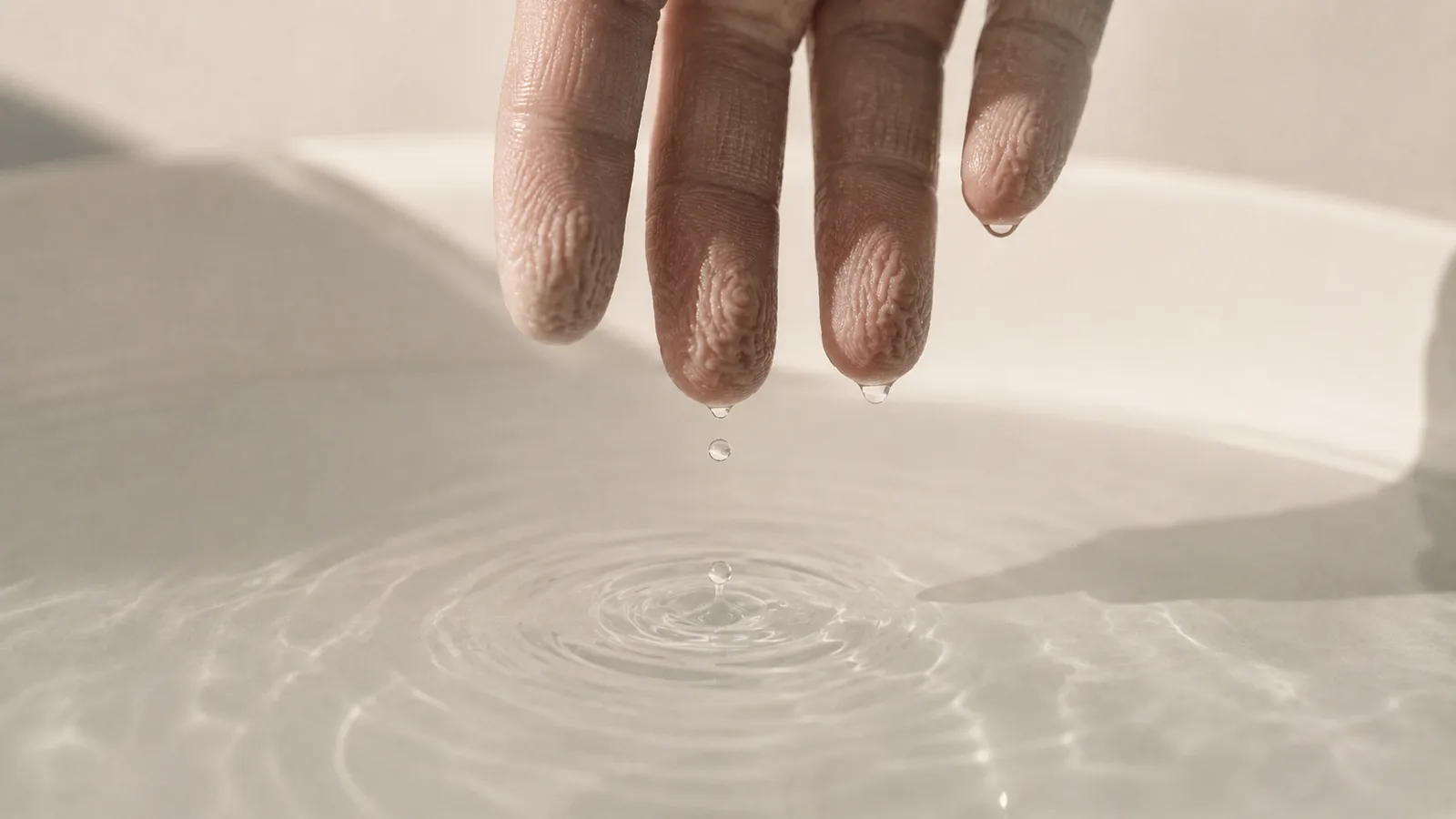
Your skin is not soaking up water. Finger wrinkling is an active process controlled by the sympathetic nervous system: blood vessels beneath the skin constrict, pulling the surface into ridges. The proof is decisive — cut the nerve supply to a finger and it stops wrinkling entirely, no matter how long it stays submerged. Whether the wrinkles are useful is a separate and unresolved question.
The osmosis explanation survived most of the twentieth century, not because it was well supported but because nobody seriously examined it. It is the best example on this site of an intuitive answer occupying a space that was never actually tested.
Why osmosis cannot be the answer
The passive-swelling story has an obvious appeal. Skin absorbs water, expands, and the excess surface area buckles into ridges. It is also inconsistent with several straightforward observations.
Start with the pattern. Wrinkling occurs only on glabrous skin — fingers, palms, soles — and not on the back of the hand, which is soaking in exactly the same bath. Passive absorption offers no reason for that boundary. That same glabrous skin is the body's most efficient radiator, which is why one foot out from under the duvet helps you fall asleep.
Then the mechanics. A 2016 biomechanical modelling study calculated that producing the observed wrinkle patterns through swelling alone would require the tissue to expand by at least 20 percent beyond its normal volume. Nothing close to that happens.
And the timing. Wrinkling takes several minutes to develop and reverses within minutes of leaving the water. Passive diffusion through the stratum corneum is not that fast in either direction.
The observation that settled it
The decisive evidence is nearly a century old and was largely ignored when it appeared. In the 1930s, clinicians observed that patients with severed nerves supplying a finger did not develop wrinkles in that finger, while their intact fingers wrinkled normally in the same water.
Water cannot tell which of your fingers has an intact median nerve. If wrinkling were a physical consequence of immersion, denervation would make no difference whatsoever. It makes all the difference, which means the process is being actively driven by the nervous system.
The mechanism is sympathetic vasoconstriction. Immersion triggers constriction of blood vessels beneath the glabrous skin, reducing the volume underneath and drawing the surface down into the characteristic ridges. Later work confirmed this directly — measurements show reduced digital artery flow accompanying wrinkling, and applying a local anaesthetic that causes vasoconstriction produces similar wrinkling with no water involved. It is the same category of finding as a foot going numb: interrupt the nerve and the phenomenon disappears, whatever else is happening to the tissue.
Medicine noticed before biology did
Because wrinkling depends on intact sympathetic innervation, it works as a test. Stimulated skin wrinkling has been used clinically as a simple, non-invasive indicator of sympathetic nerve function and of peripheral nerve integrity — a bucket of warm water standing in for more elaborate equipment.
This is a nice illustration of how the phenomenon was understood as diagnostic long before anyone asked what it was for.
What changes how fast it happens
Because the response is vascular rather than absorptive, the things that speed it up are the things that affect the vasculature — and researchers have mapped them systematically by timing how long immersion takes to reach a defined degree of wrinkling.
Warm water wrinkles fingers faster than room-temperature water, and iced water slows the process. Tonicity matters: hypertonic saline accelerates wrinkling relative to plain water, and distilled water behaves differently again. Soapy or altered-pH solutions change the timing too. Oil, which does not permit the same interaction with the skin surface, produces minimal wrinkling.
None of that pattern follows from a passive-absorption account, under which colder water and warmer water should differ little and salinity should work against wrinkling rather than for it.
The rain tread hypothesis
Active control implies function. Bodies do not usually run a sympathetic reflex for no reason, and this reasoning motivated the most popular modern explanation.
In 2011, Mark Changizi and colleagues noted that the wrinkle channels resemble drainage networks — branching in a pattern that would divert water away from the contact surface, like the tread on a tyre. In 2013, Kyriacos Kareklas, Daniel Nettle and Tom Smulders at Newcastle tested the prediction behaviourally: twenty participants transferred submerged objects faster with wrinkled fingers than with unwrinkled ones, with no difference when the objects were dry.
That is a clean result with a clear prediction and a matching outcome, and it is the source of the confident claim you have probably read: wrinkles improve wet grip.
The replication failure nobody mentions
In 2014, Julia Haseleu and colleagues at the Max Delbrück Center attempted the same test and could not reproduce it. They found no effect of wrinkling on dexterity in handling wet objects, and no effect on touch acuity or vibrotactile sensation either.
Their conclusion was blunt: wrinkling may serve no adaptive function at all, and may simply be a byproduct of the sympathetic vasoconstriction that warm-water immersion happens to produce. They also noted that a task measured by completion speed is sensitive to motivation and individual differences in fine motor control — factors independent of grip.
So the honest state of play is: the mechanism is settled and the function is not. One study found a wet-handling advantage, one found none, and both were small. Recent work has continued on the descriptive side — a 2025 study found that an individual's wrinkle topography is repeatable across separate immersions, consistent with fixed underlying vascular anatomy — without resolving the functional question.
What to take away
- Wrinkling is nerve-driven, not water-driven. Denervated fingers do not wrinkle.
- The mechanism is sympathetic vasoconstriction beneath glabrous skin.
- It occurs only on fingers, palms and soles — the same skin types that lack hair follicles.
- It is used clinically as an indicator of sympathetic nerve function.
- Whether it improves wet grip is genuinely contested, with one supporting study and one failed replication.
Which makes it an unusually good example of how these things go. A satisfying explanation held for a century without being tested, the real mechanism turned out to be a vascular reflex, and the tidy evolutionary story that replaced the myth is itself less secure than its retelling suggests. The underlying control system — autonomic regulation of blood vessels producing a visible change in the skin — is the same one behind a signal you cannot fake or suppress.
Same trick, different system
The Dunning-Kruger Effect: What It Actually Says
Frequently asked questions
Not from absorbing water. Immersion triggers sympathetic vasoconstriction in the blood vessels beneath the glabrous skin of fingers, palms and soles, reducing the volume underneath and pulling the surface into ridges. It is an active nervous-system process.
Fingers with severed nerve supply do not wrinkle at all, while intact fingers in the same water do. Water cannot distinguish between them. Modelling work also shows passive swelling would need roughly 20 percent volume expansion to produce the observed patterns.
This is contested. A 2013 study found participants transferred submerged objects faster with wrinkled fingers, but a 2014 attempt found no effect on dexterity or touch acuity and suggested wrinkling may be a byproduct with no adaptive function.
Wrinkling is restricted to glabrous — hairless — skin, which has the vascular arrangement that responds this way to sympathetic activation. The back of the hand is immersed in the same water and does not wrinkle.
Yes. Because it depends on intact sympathetic innervation, stimulated skin wrinkling has been used as a simple non-invasive indicator of sympathetic nerve function and peripheral nerve integrity.
This article is educational science trivia about everyday human biology and psychology. It is not medical advice, diagnosis, or treatment, and it is not a substitute for care from a qualified professional.