Why One Foot Outside the Blanket Helps You Sleep
The one-foot-out trick is real, and it works because of a thermostat in your skin.

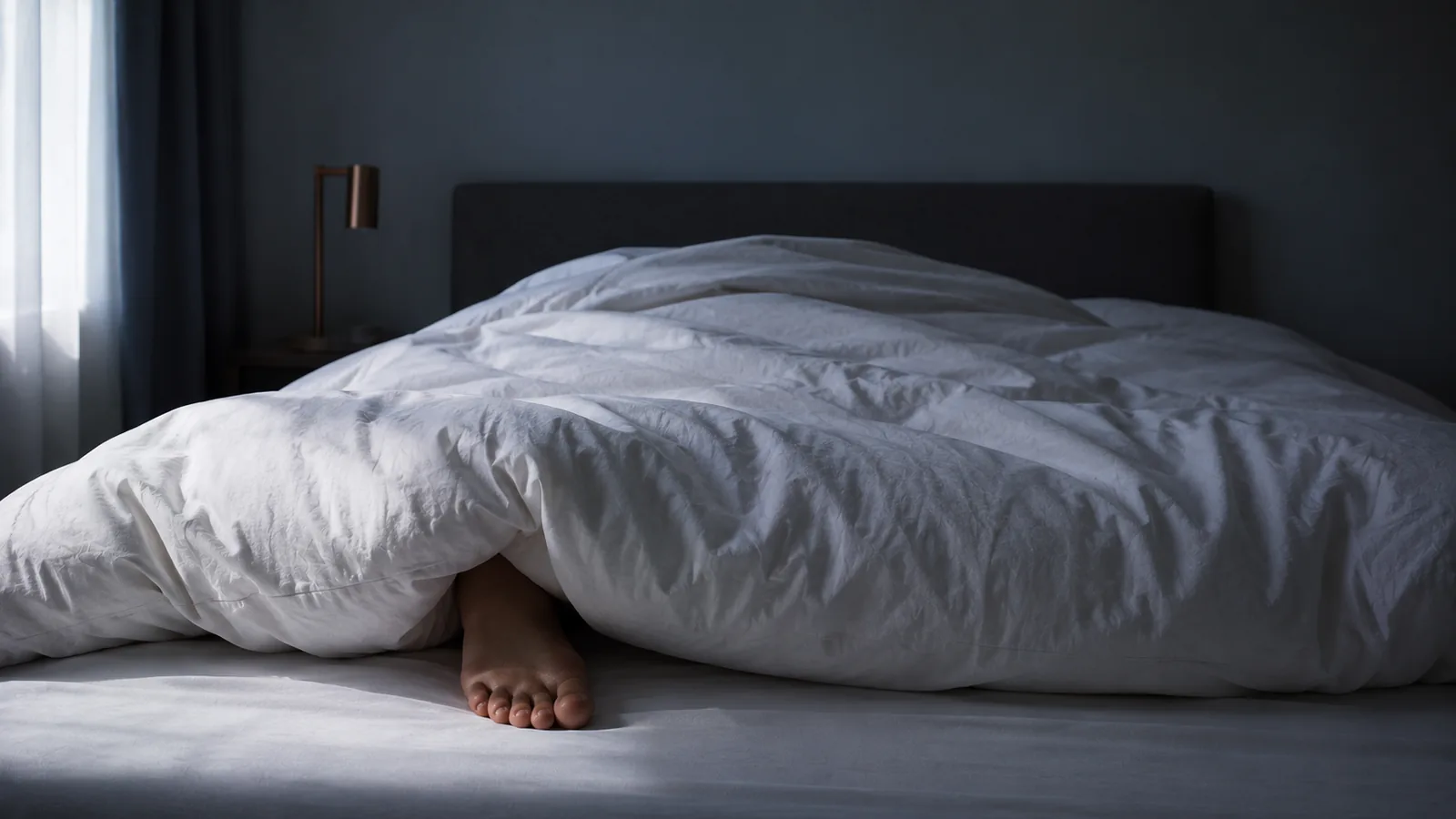
Falling asleep requires your core temperature to drop, and the fastest way to dump heat is through the soles of your feet — which contain dense arteriovenous anastomoses, direct artery-to-vein shunts capable of enormous rapid changes in blood flow. Sticking one foot out puts a purpose-built radiator in contact with cool air. The physiology is solid; the specific behaviour has never been studied.
It is one of the most widely recognised sleep habits there is, and one of the few with a genuinely satisfying mechanical explanation sitting underneath it.
Sleep needs you to cool down
Core body temperature follows a daily rhythm, peaking in the early evening and falling through the night to a minimum in the early hours. That decline is not incidental to sleep — it is part of the process of initiating it, and the drop of roughly a degree Celsius across the night is closely tied to sleep onset and maintenance.
The interesting question is how the body achieves the drop. Heat has to go somewhere, and the route is through the skin. But not all skin is equally suited to the job.
The radiators in your feet
Glabrous skin — hairless skin, found on the soles, the palms, and parts of the face — has a vascular arrangement found nowhere else. It contains arteriovenous anastomoses: direct connections between small arteries and veins that bypass the capillary beds entirely.
These shunts exist for temperature control rather than for supplying tissue. When open, they permit very large volumes of warm blood to flow close to the surface and lose heat rapidly; when closed under sympathetic vasoconstriction, blood is diverted away and heat is conserved. The range between the two states is dramatic — far greater than anything ordinary skin can achieve.
It is the same unusual skin type, under the same sympathetic control, that produces the other well-known glabrous quirk on this site — wrinkling in water is vasoconstriction in exactly these vessels, which is why denervated fingers do not wrinkle.
The evidence for the mechanism
The link between distal skin warming and sleep onset was established in the late 1990s by Kurt Kräuchi and colleagues, who measured skin temperatures at various body sites alongside sleep latency.
The best predictor of how quickly someone fell asleep was not core temperature, nor overall skin temperature, but the distal-proximal gradient: the difference between temperature at the extremities and at the trunk. Warm hands and feet relative to the torso — indicating open shunts and active heat loss — predicted rapid sleep onset.
This is where the counterintuitive part comes in, and where most popular explanations get confused. Warm feet promote sleep because warm feet mean heat is being dumped. The vasodilation is the mechanism; the warmth is the visible sign of it. Cold feet usually indicate closed shunts and retained heat, which is the opposite of what sleep onset requires.
Why bed socks and a bare foot both work
These look like contradictory advice and are not. Warming cold feet with socks triggers vasodilation, opening the shunts and allowing heat to escape. Exposing a foot to cool air provides a steep thermal gradient across skin that is already dumping heat. Both increase net heat loss from the core; they just start from different places.
Which one helps depends on where you are starting. Someone whose feet are cold benefits from warming them. Someone whose feet are already warm under a heavy duvet benefits from uncovering one.
Why one foot rather than two
This is where the evidence stops and the reasoning starts. The plausible answer is proportionality: the amount of heat you need to lose is modest, and one foot supplies enough surface area without overshooting into the discomfort of being cold.
A single foot also offers something two do not — a control. Thermoregulation is a feedback process, and one exposed foot allows continuous fine adjustment: further out if too warm, tucked back if too cool, without disturbing the rest of the arrangement.
That is a plausible account rather than a finding. Nobody has studied the one-foot-out behaviour specifically, compared it against two feet, or measured its effect on sleep latency. The thermoregulatory physiology it rests on is thoroughly established; the specific habit is an inference from it.
Why feet and not hands
Palms are glabrous too, with the same arteriovenous anastomoses, and they do the same job — the distal-proximal gradient research measured both. So why is the foot the one that comes out from under the duvet?
Mostly because hands are usually already available. Sleeping postures leave hands near the edge of the covers or outside them without deliberate effort, while feet sit at the far end of the bed, deepest inside the insulation and hardest to expose by accident. If you need additional heat loss, the foot is the surface that requires an actual adjustment to free.
Infants make the same physiology visible in a different way. Their hands and feet are commonly cool to the touch while their trunk is warm — the same distal vasoconstriction, in a body with a much higher surface-area-to-volume ratio and a less developed capacity to regulate, which is a large part of why overheating guidance for infant sleep is so specific.
What follows from this
The temperature findings do support the general sleep advice about a cool bedroom, which is unusual for sleep-hygiene guidance in having a clear mechanism behind it. A room that lets you lose heat easily makes the core temperature drop easier to achieve.
It also explains why sleep is difficult in hot weather in a more specific way than mere discomfort. If ambient temperature is too high, the gradient driving heat away from your skin shrinks, and the core temperature decline that sleep onset depends on cannot proceed at its normal rate. You are not just uncomfortable; the physiological precondition is being obstructed.
And it places this quirk inside a larger picture of sleep as an actively managed process rather than a passive shutdown — the same system that produces a hormonal ramp timed to your expected waking hour is also running your temperature curve, and the foot outside the blanket is you helping it along without knowing why.
Same trick, different system
Pins and Needles: What’s Happening When Your Foot Falls Asleep
Frequently asked questions
Falling asleep requires core temperature to drop, and the soles of the feet contain arteriovenous anastomoses — direct artery-to-vein shunts built for dumping heat rapidly. Exposing one to cool air provides an efficient route for that heat loss.
Because warm feet indicate the heat-dumping shunts are open. Research found that the temperature difference between extremities and trunk was the best predictor of sleep onset — warm hands and feet relative to the torso meant heat was actively being lost.
No. Warming cold feet triggers vasodilation and opens the shunts; exposing a warm foot provides a steep gradient for heat to escape. Both increase net heat loss from the core, starting from different conditions.
The likely answer is that one supplies enough surface area without overcooling, and allows continuous fine adjustment — further out or tucked back — as conditions change. This is reasoning from the physiology rather than a studied finding.
A hot room reduces the thermal gradient driving heat away from your skin, so the core temperature decline that sleep onset depends on cannot proceed normally. The problem is not only discomfort but obstruction of a physiological precondition.
This article is educational science trivia about everyday human biology and psychology. It is not medical advice, diagnosis, or treatment, and it is not a substitute for care from a qualified professional.